
MARKUP AI VS. GRAMMARLY
Grammarly fixes the sentence. Markup AI tells you when the content is ready.
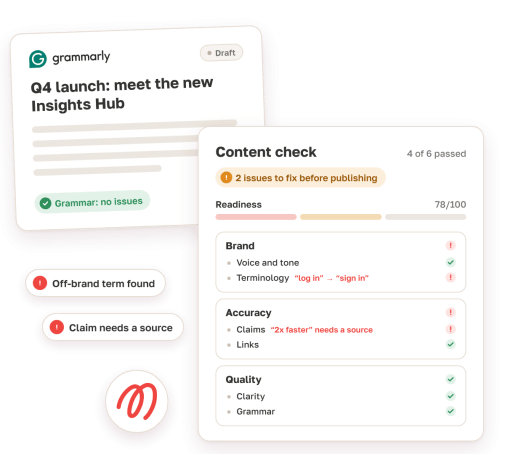
Grammarly helps each writer polish what they type. Markup AI checks the finished piece against your style guide, your audience, your facts, and AI search before it publishes. It works on content from any writer or AI tool.

TRUSTED BY


AT A GLANCE
Two tools. Two different jobs.
One helps each writer. The other governs everything you publish.
| Comparison |  For review before publish |  For everyday writing |
|---|---|---|
| What it is | A content control layer that reviews content before it's published. | An AI writing assistant that suggests edits as each person types. |
| Built for | Teams publishing brand, product, and AI-assisted content at scale. | Individuals and teams improving everyday writing. |
| Where it runs |  Google DocsMicrosoft WordChatGPTBrowser extensionClaude via MCPAPIZapiern8nAEM GuidesHerettoMadCap Flare | Browser extensionMicrosoft WordGoogle DocsDesktop appsGmailOutlookSlackGrammarly docs |
| Checks brand voice on finished content | Yes. Wherever the draft came from, with a per-run audit trail. | Partly. Brand tones give feedback while each person writes. |
| How it decides | Deterministic rules engine plus AI review. | AI suggestions plus phrase-level style rules. |
| Pricing model | Starter from $249 per month with annual discount. No per-seat fees. | Pro from $12 per member per month, billed annually, up to 149 seats. Enterprise through Superhuman Go. |
| Free trial | 30 days | Free plan, plus a Pro trial |
See how a check works on your own content.
KEY DIFFERENCES
Three things Markup AI does that Grammarly doesn't.
Grammarly makes each writer better. These three gaps are why teams switch to Markup AI.

Checks the finished piece, not just the sentence.
Grammarly suggests edits as each person types. Markup AI reviews the whole draft for brand, audience, accuracy, and AI citability before it goes live, whether a person or an AI tool wrote it.
A real API, not just a score.
Grammarly's Writing Score API returns scores only, with no issues and no style guide. Markup AI returns every issue with its reason and a fix, through the API, MCP, or your CCMS.

One price for the whole team.
Grammarly charges per member, and Pro stops at 149 seats. Every Markup AI plan covers your whole team, so you can add writers, reviewers, and agencies without recounting licenses.
SWITCHING FROM GRAMMARLY?
Switch from Grammarly. Keep your standards.
Moving off Grammarly doesn't mean starting over. Your style guide, brand terms, and tone rules move into one central standard. That standard runs wherever content gets made: in the editors your writers already use, in the AI tools drafting for them, and in the systems that publish.

Load your standard
Bring your style guide, terminology, and brand voice into Markup AI once. Every writer and tool checks against it.

Check where content is made
Run checks in the editors, AI tools, and CCMS your team already uses, or through the API.
Gate it. Publish.
See a score and fix what's flagged before you publish.
FEATURE COMPARISON
Feature by feature, side by side.
How the two compare across six areas that decide whether content is ready.

Full support
Partial or limited
Not available
Brand and style control
Grammarly adjusts tone and wording as people write. Markup AI enforces your full standard on the finished piece.
| Capability | | |
|---|---|---|
| Checks content against general voice and tone rules | Yes | Yes |
| Enforces a custom style guide | Yes | Partial Phrase-level rules. One style guide on Pro |
| Applies brand terms | Yes | Partial Word and phrase rules, plus Knowledge Share |
| Advanced terminology management (1,000+ terms) | Yes | No |
| Checks brand voice on finished content | Yes Wherever the draft came from | Partial Brand tones give feedback while each person writes |
| Applies brand voice at generation | No Markup AI does not generate content | Partial AI drafts reflect your brand voice |
| Flags AI-sounding copy | Yes | Yes AI detector and Authorship |
| Rewrites unclear sentences | Yes | Yes |
| Character-level issues with rationale and ranked fixes | Yes | Partial Inline suggestions, no ranked fixes |
| Deterministic rules engine, not LLM-only | Yes | Partial Style rules are rule-based. Tone and agents use AI |
Bottom line:
Grammarly matches Markup AI on tone, AI-sounding copy, and sentence rewrites, and edges ahead on brand voice at generation. Markup AI leads on style guide depth, terminology management for 1,000+ terms, and checks on the finished draft.
Audience and persona simulation
Both can model a reader. Only Markup AI scores the finished piece against a detailed persona.
| Capability | | |
|---|---|---|
| Reusable audience and persona profiles | Yes | Partial Custom audiences in Reader Reactions, inside Grammarly docs |
| Scores finished content against a named persona | Yes | Partial Predicted reader reactions, not a score |
| Deep persona modeling (skepticism, trust triggers, pet peeves, buying authority) | Yes | No |
Bottom line:
Grammarly's Reader Reactions predicts how a reader might respond, inside Grammarly docs. Markup AI scores the finished piece against a detailed buyer persona, wherever it was written.
Accuracy and compliance
Claims, links, dates, and sources. AI drafts get teams into trouble here most often.
| Capability | | |
|---|---|---|
| Unsupported claim and promissory language detection | Yes | Partial Citation Finder flags claims that may need support |
| Link verification (404s, domain decay, anchor and URL mismatch) | Yes | No |
| Freshness checks (stale dates, stats, references) | Yes | No |
| Source authority (claims lacking credible sourcing) | Yes | Partial Citation Finder suggests sources |
| Plagiarism check | No | Yes Included on Pro |
Bottom line:
Grammarly has the plagiarism check and a citation helper. Markup AI checks claims, links, freshness, and source authority on every piece.
AI citability for AEO and GEO
Whether AI search engines can find, quote, and trust what you publish.
| Capability | | |
|---|---|---|
| Snippet readiness (sections that stand alone when quoted) | Yes | No |
| Q&A structure and answer-first checking | Yes | No |
| Key takeaways present near the top | Yes | No |
| Off-topic and fluff detection | Yes | No |
| AI-visibility rank tracking and reporting | No | No |
Bottom line:
Neither tool tracks AI-visibility rankings. Only Markup AI checks whether the content itself is ready to be quoted by AI search.
Deployability and integrations
Where the check runs, and whether it can block a publish.
| Capability | | |
|---|---|---|
| API-first: checks callable from any system | Yes | Partial Writing Score API returns scores only |
| MCP integration | Yes | No |
| Checks run inside LLM chat surfaces (ChatGPT, Claude) | Yes | No |
| Browser extension for authors | Yes | Yes |
| Google Docs and Microsoft Word | Yes | Yes |
| Automated gate before publish (risk score in workflow) | Yes | Partial Score-only API, no built-in gate |
| Generates content and images | No Not what Markup AI is for | Partial Text only. 2,000 AI prompts per member on Pro |
Bottom line:
Grammarly runs in more apps. Markup AI runs in more of your workflow: a full API, MCP, checks inside ChatGPT and Claude, and a gate before publish.
Security and governance
Both clear the enterprise basics. The difference is what you can see and prove afterwards.
| Capability | | |
|---|---|---|
| One central standard applied to every surface | Yes | Partial Style rules and brand tones aren't applied through the API |
| Org-wide content quality reporting (not seat usage) | Yes | Partial Team analytics, mostly usage-based |
| Per-run audit trail on every check | Yes | No |
| SSO/SAML and role-based access | Yes | Yes Enterprise plan |
| SOC 2 Type II and GDPR | Yes | Yes |
| Professional services | Yes | Partial Dedicated support on Enterprise |
Bottom line:
Both meet enterprise security requirements, and Grammarly lists more ISO certifications. Markup AI reports on content quality across the org and keeps a per-run audit trail.
We based these ratings on our review of each product's public documentation and plans, last checked October 2026. Full means included, partial means limited or plan-gated, and none means we couldn't find it. Tell us if something changed, and we'll update it.
FAIR IS FAIR
Where Grammarly is the stronger choice.
Grammarly is a strong everyday writing assistant. Here's where it does more than Markup AI.
Generating text
Grammarly Pro includes 2,000 AI prompts per member each month for drafting and rewriting. Markup AI checks content. It doesn't generate it.

Everyday writing in every app
Grammarly says it works across more than 1 million apps and sites, from e-mail to chat. Markup AI focuses on the places content gets authored and published.
Plagiarism and AI-text detection
Grammarly Pro includes a plagiarism checker and an AI detector. Markup AI flags AI-sounding copy but doesn't check for plagiarism.
A free plan for individuals
Grammarly offers a free plan and a low per-person Pro price. That pricing suits individuals and small teams who don't need a shared standard.
PRICING
Per seat, or one price for everyone.
Grammarly charges per member. Markup AI plans cover your whole team, so cost tracks the content you check, not headcount.
Markup AI
Flat price. Your whole team. 30-day free trial.
Starter
$249 / month
With annual discount. 12 million words checked a year. Review for brand, quality, and citability. Centralized administration.
Business
$999 / month
With annual discount. 50 million words checked a year. Priority ticket-based support.
Enterprise
Custom
Custom word volume, advanced standards powered by Acrolinx, SSO/SCIM, dedicated Customer Success Manager.
Grammarly
Per member. Free plan available.
Pro
$12 / member / month
Billed annually, or $30 monthly. 1–149 seats. One style guide, one brand tone, Knowledge Share, team analytics, plagiarism and AI-text detection, and 2,000 AI prompts per member per month.
Enterprise
Contact sales
Sold through Superhuman Go. Unlimited members, style guides, and brand tones, plus SAML SSO, SCIM, and an Audit Logs API.
How the prices compare
Grammarly Pro costs $12 per member a month. At 21 members, that's $252 a month, more than Markup AI Starter at $249 a month for your whole team. Both figures assume annual billing.
We pulled prices from markup.ai/pricing and grammarly.com/plans in October 2026. Check each site for current rates.

“Markup AI is one of the few integrated things with AEM Guides that has AI... that's less copy and pasting and less barrier for your authors.”
WHO IT IS FOR
Pick the tool for the job you actually have.
Both tools improve writing. The question is whether you need better sentences or publish-ready content.
Markup AI is right for you if:
Grammarly is right for you if:
Already paying for Grammarly seats? Run both on the same draft during your 30-day trial and compare what each one catches.
FREQUENTLY ASKED QUESTIONS
Questions people ask before they switch from Grammarly.
For teams that publish under a brand, yes. Markup AI covers style, terminology, clarity, and tone. It adds what Grammarly doesn't check: audience fit, claims, links, freshness, and AI citability. Results are scored against one central standard, with an audit trail on every run.
Yes. Markup AI checks finished content from any source: a writer, an agency, ChatGPT, Claude, or another AI tool. Run it in Google Docs, Word, Chrome, your CCMS, or through the API.
Grammarly's style rules flag specific words and phrases and give feedback as each person types, and Pro includes one style guide and one brand tone. Markup AI runs a deterministic style engine with advanced terminology management for 1,000+ terms. It also checks brand voice on the finished piece and logs every check.
Grammarly Enterprise is now sold through Superhuman Go, a broader suite of AI productivity agents. Grammarly still checks writing per person, in the editor. Markup AI does one job: it governs the quality of content before it publishes.
Plans start at $249/month (annual) for Starter and $999/month for Business, and Enterprise pricing is custom. Every plan covers your whole team, so pricing follows the volume of content you check, not your headcount.
Yes. Every new account gets a free 30-day trial.
Yes. Markup AI is SOC 2 Type II certified and GDPR compliant, with SSO/SAML, SCIM, and role-based access on Enterprise. Every check gets a per-run audit trail. See our Trust Center for details.
MORE COMPARISONS
How Markup AI compares to other solutions.


GET STARTED
Know your content is ready before it goes out.
Start your free 30-day trial and run your first check on something your team already polished in Grammarly. Or talk to us about moving your standards into your workflow.