
Marketing and AI Guide for Content Teams
 •
May 1, 2026
•
May 1, 2026

Key takeaways:
- Marketers are under intense pressure to produce high-quality content across multiple channels, and AI offers a way to scale rapidly.
- Relying solely on generative AI without human oversight can destroy your brand voice and alienate your core audience.
- The key to success with marketing and AI is building a partnership where AI handles the heavy lifting and humans provide the creative strategy.
- Content Guardian AgentsSM automatically enforce your brand guidelines, ensuring consistency across every blog, email, and social post.
- Integrating guardrails into your CMS allows your marketing team to scale with absolute confidence.
The modern marketer’s dilemma
If you’re a marketing professional, you’re likely caught in a relentless tug-of-war. On one side, there’s an insatiable demand for more content — more blog posts, more email nurture flows, more social media updates, and more personalized landing pages. On the other side, there’s the absolute necessity of maintaining high-quality content without the support of more people to oversee it.
Generative AI is the ultimate tool to resolve this tension. It accelerates content production, eliminates writer’s block, and helps teams iterate on campaigns at lightning speed. However, as many marketers are quickly discovering, AI is a double-edged sword.
When you ask an AI model to write a campaign, it often produces text that is generic, repetitive, or completely disconnected from your brand’s unique tone. If your brand is known for being approachable and conversational, an AI might output dense, jargon-heavy paragraphs. If you don’t have a system in place to control this output, your audience will quickly notice the drop in quality, and your brand equity will suffer.
What marketers use AI for today
Before diving into how to govern AI output, it helps to understand where marketing teams are already putting it to work. Adoption is accelerating fast, and use cases have matured well beyond simple first-draft generation:
- Drafting and copywriting: AI can generate first drafts of blog posts, emails, ad copy, and landing pages in seconds — giving writers a structured starting point rather than a blank page.
- Ideation and brainstorming: Teams use AI to rapidly generate headline variations, campaign angles, and content themes, compressing what used to be hours of creative development into minutes.
- Personalization at scale: AI enables dynamic content that adapts messaging based on audience segment, funnel stage, or behavioral signals — something impossible to do manually at volume.
- Campaign support: From brief writing to asset naming conventions to metadata generation, AI handles the operational layer of campaign execution that slows teams down.
- Workflow acceleration: AI trims the time spent on research, competitive analysis, repurposing long-form content into social snippets, and translating assets across markets.
The common thread across all of these is speed. But speed without guardrails is where brand risk enters the picture.
Mastering marketing and AI
Imagine your brand as a finely tuned orchestra. Every element — from your website copy to your event brochures — plays a vital role in the harmonious symphony of your business. Now, picture generative AI as an enthusiastic new musician eager to join the ensemble. The challenge is making sure this new player doesn’t turn your brand’s melodious performance into mere noise.
In the realm of AI-enhanced content creation, your brand’s voice is the conductor’s baton. It directs the ensemble with precision and flair. To master marketing and AI, you must establish clear AI guardrails that keep the AI playing the right notes.
This is where Markup AI steps in as the maestro. We ensure that AI’s contribution improves rather than disrupts your brand harmony. By seamlessly integrating with your authoring tools, we offer real-time guidance to your writers and instant corrections to your AI drafts.
How to build an automated content engine
To effectively leverage AI in your marketing workflows, you need to implement a system that guarantees consistency. Here’s a three-step approach to scaling your marketing content safely:
1. Define your brand composition
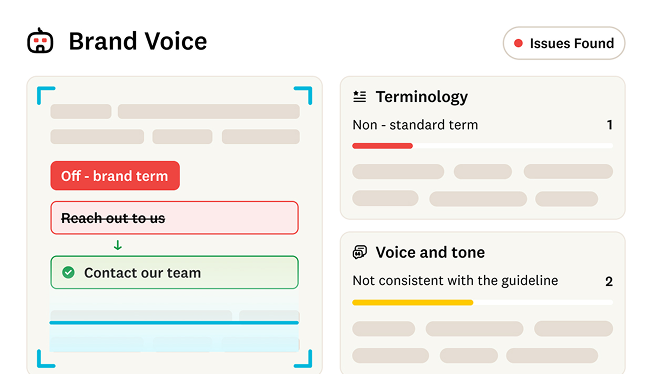
Before you automate quality, you must define it. Create a centralized source of truth for your brand voice, tone, and terminology. Document the specific words you favor, the phrases you avoid, and the stylistic choices that define your company.
2. Integrate guardrails into your workflow
Don’t wait until a draft is finished to check if it sounds like your brand. Integrate Markup AI directly into your content management system or writing environment. Our platform evaluates every sentence against your specific criteria, ensuring your tone remains captivating.
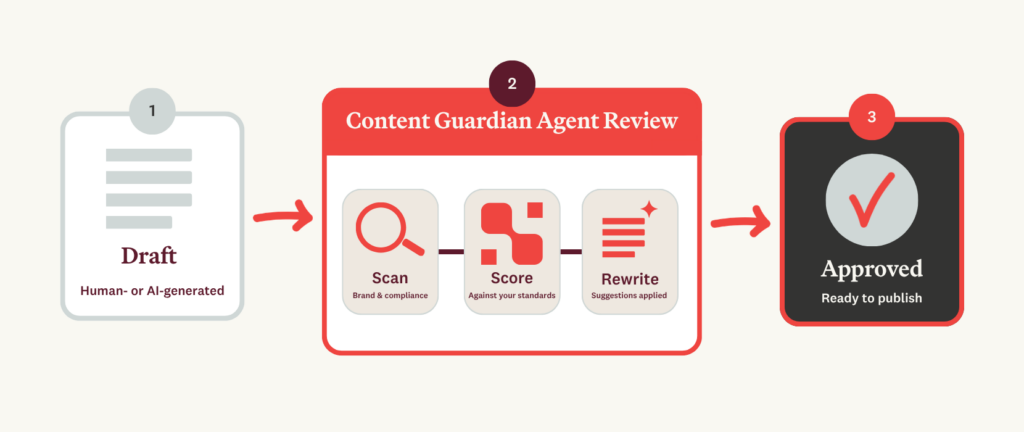
3. Scan, score, and rewrite
Make it a mandatory process for your team to scan every AI-generated draft. Markup AI will score the content for brand consistency, clarity, and engagement. If a section is off-brand, Content Guardian Agents will automatically rewrite the flagged sections before publishing, ensuring total compliance with your style guide.
A simple workflow for marketing teams
Enterprise teams often ask how to operationalize these three steps without disrupting existing processes. Here’s a lightweight implementation model that works whether your team is five people or five hundred:
1. Start with a brand audit. Before rolling out AI tooling, document your current brand voice in a shared style guide. Include real examples of on-brand and off-brand copy so your guardrail configuration is grounded in actual usage, not abstractions.
2. Run a pilot on one content type. Choose a high-volume, lower-stakes asset — weekly social posts or nurture emails work well — and run all drafts through Markup AI before publishing. This creates a tight feedback loop without putting flagship content at risk.
3. Measure and expand. After four to six weeks, review brand consistency scores, time-to-publish metrics, and editor revision rates. Use that data to make the business case for expanding the workflow to additional content types and teams.
4. Automate the compliance layer. Once your style guide is tuned, enable Content Guardian Agents to handle flagged rewrites automatically. Your team reviews and approves; the agent handles the remediation.
This approach lets enterprise marketing organizations adopt AI responsibly — with clear accountability at each stage and measurable quality outcomes from day one.
Empowering your marketing team
Markup AI doesn’t replace your marketing team; it empowers them. By automating the tedious task of tone-checking and copy-editing, your marketers gain the freedom to focus on what they do best: understanding the customer, designing innovative campaigns, and driving revenue.
You ensure clarity, enforce quality, and integrate guardrails across every channel and asset. Inclusion, relevance, impact, and clarity become automated features of your content rather than manual problems to be solved.
You don’t have to sacrifice quality for speed. By harnessing both AI efficiency and automated brand enforcement, you can transform potential content problems into opportunities for market leadership.
Ready to elevate your marketing?
Build faster and safer. Download the full guide to scaling generative AI content workflows and learn how to perfect the human-AI partnership.
Frequently Asked Questions (FAQs)
What is AI used for in marketing?
AI is used to draft content, brainstorm ideas, personalize campaigns, and speed up content production while teams keep human oversight.
How can marketers protect brand voice when using AI?
Use clear brand rules, review workflows, and automated guardrails that flag or rewrite off-brand text before publishing.
What are the biggest risks of AI-generated marketing content?
Generic tone, inaccuracies, inconsistency, and compliance issues are the main risks when teams rely on raw model output.
How does Markup AI fit into a marketing workflow?
It scans, scores, and rewrites content inside existing workflows so teams can publish faster without losing control.
Can AI be used across different content formats?
Yes, the same controls can be applied to blogs, emails, landing pages, and social content with format-specific scoring.
Last updated: June 24, 2026
Charlotte Baxter-Read
Continue reading

How to Use Claude for On-Brand Content (And Actually Verify It)
 •
September 24, 2026
•
September 24, 2026

MarkupAI a Finalist in The 2026 AI Awards
 •
September 22, 2026
•
September 22, 2026