
“The Docs Are Not Alright” and Other Takeaways from LavaCon 2026
 • November 12, 2026
Key takeaways:
- Technical writers are facing a real identity shift as AI changes who content is written for, who writes it, and how it gets used.
- Content is becoming more important, not less. If AI systems rely on your documentation, your docs need to be accurate, structured, complete, and trustworthy.
- Many teams face AI mandates without the budget, training, or support to execute them.
- Larger content organizations are moving toward content ops, content engineering, taxonomy, ontology, and AI-ready knowledge systems.
- AI can help generate and manage content, but humans still need to define standards, guide workflows, and decide what’s good enough to publish.
At the end of October, the Markup AI team attended LavaCon 2026, and one thing was clear: documentation teams are redefining their role in the age of AI.
Across sessions, networking events, and karaoke-adjacent conversations, we heard the same theme again and again: AI is changing the role of technical writers and content teams.
The takeaway: documentation is becoming more important, not less. In an AI-driven company, documentation may become one of the most important knowledge assets in the business.
What is LavaCon?
LavaCon is a conference for professionals working in content strategy, content operations, and technical communication. It brings together the people responsible for making complex information usable, findable, structured, and trustworthy.
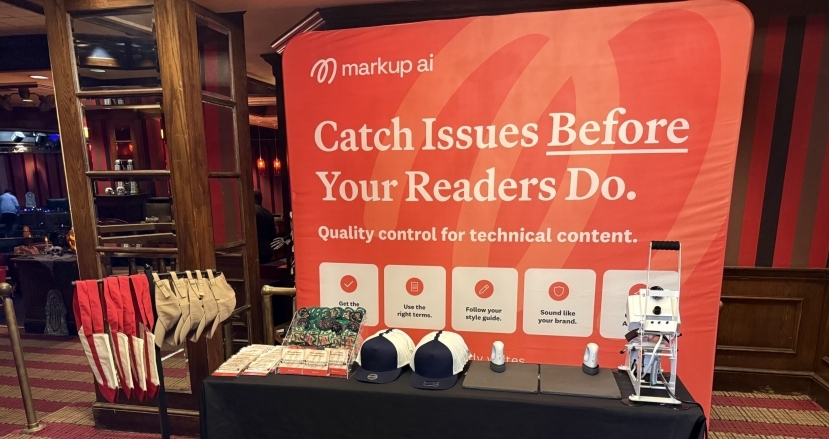
Markup AI was honored to be part of LavaCon this year through sponsorship, speaking sessions, the Adobe Executive Networking Reception, and last but certainly not least, the karaoke night we co-hosted with Heretto.
What we heard at LavaCon
Technical writers are asking what comes next
One of the biggest themes at LavaCon was the changing role of the writer.
Documentation has traditionally meant people writing for people. Now, teams are also dealing with people writing for machines, machines writing for people, and machines writing for machines. That shift is creating a real identity crisis for technical writers and documentation teams.
If AI can draft release notes, summarize documentation, answer customer questions, and generate internal knowledge, what is the writer’s role?
A common answer we heard: writers are becoming more like facilitators, orchestrators, and systems thinkers.
The work is shifting from “write every word” to “manage the requirements, standards, inputs, workflows, and outputs.” In short, the role is becoming more strategic. Someone still has to decide what the source of truth is. Someone still has to define what “correct” means. Someone still has to understand the user, the product, the context, and the risk.
AI can generate content, but it doesn’t own the consequences.
Content quality now matters even more
Another major theme: content has to be trustworthy before it enters the AI systems that depend on it. Incomplete, outdated, inconsistent, or unclear content contaminates everything downstream.
That includes:
- Customer-facing AI assistants
- Internal knowledge agents
- Support workflows
- Sales enablement
- Product documentation
- Training materials
- Search and answer experiences
- Automated content generation
The idea is simple: don’t wait until the model produces a bad answer to worry about quality. Improve the content, context, structure, and governance before information gets pulled into the AI system.
Teams are being handed AI mandates without enough support
This was one of the more sobering themes. We heard from teams that are under pressure to adopt AI but don’t have the budget, training, staff, or process to do it well.
The mood in these conversations wasn’t one of AI resistance. It was more like: “We know this matters. We know we have to figure it out. We’re just not sure how we’re supposed to do that while still doing everything else.”
Larger teams are reinventing documentation as content operations
On the other end of the spectrum, we met teams, especially in larger technical organizations, that are already deep into reinvention.
These teams are moving beyond traditional technical writing and into content operations, content engineering, and automated documentation workflows. They’re stitching systems together to draft content, manage knowledge bases, and feed internal AI tools.
Once automation is in place, though, a new problem appears: how do you make sure the content entering the system is optimized, consistent, accurate, and efficient?
As companies build AI workflows, bloated or poorly structured content actually can make systems more expensive and less effective. Suddenly, clean content architecture isn’t just an editorial concern. It’s an operational and financial one.
Taxonomy and ontology are having their main character moment
Enterprise teams are building structured knowledge systems to support AI, especially internal agentic tools. Taxonomy helps classify and organize content. Ontology goes deeper, defining relationships between concepts, entities, products, audiences, tasks, and knowledge areas.
Large organizations need more than a pile of content. They need structured, contextual, trustworthy knowledge that AI systems can actually use. For smaller teams, this may not mean building a full ontology tomorrow, but the direction is clear. Structure, relationships, and context matter.
What we shared at LavaCon
Markup AI also had the chance to contribute to the conversation through two speaking sessions.
Our VP of Product, Kayce Danna, presented “The Docs Are Not Alright (And AI Alone Won’t Fix Them).” She focused on the reality many documentation teams are facing: the pressure to modernize with AI while still dealing with broken workflows, unclear ownership, inconsistent standards, and growing content demands.
Brittany Dickson, our Senior Director Customer Success and Services in the US, presented “Thomson Reuters’ Human-Guided Approach to AI Content” alongside Emily Byrnes from Thomson Reuters and Mike Buoy from Adobe. The session explored how teams can use AI while keeping humans involved in the decisions that matter: quality, accuracy, brand alignment, and trust.
That theme came up everywhere. AI can help, but AI alone is not the answer.
What this means for content and documentation teams
The work is changing. Writers, documentation leaders, and content teams are becoming stewards of knowledge systems. They are defining standards, structuring information, managing workflows, improving source content, and helping AI systems produce better outputs.
The content supply chain matters more than ever. Before content reaches a customer, an AI agent, a support rep, a sales team, or an internal knowledge base, teams need confidence that it is:
- Accurate
- Complete
- Structured
- On-brand
- Current
- Contextual
- Approved
- Fit for use
That’s a content governance problem, and honestly, it’s also an opportunity.
For years, documentation teams have known that clear, trustworthy content impacts customer experience, support volume, product adoption, and brand trust. AI is actually making that value harder to ignore.
If businesses want better AI outputs, they need better content inputs.
Thank you, LavaCon
If you chatted with us, came to one of our sessions, met us at the reception, or sang your heart out with us at karaoke, thank you. Thank you also to the LavaCon team for putting on such an incredible event!
We left LavaCon 2026 energized by the conversations we had with you and convinced that technical documentation writers are still vital in the age of AI. They’re the people who make AI usable, trustworthy, and worth putting in front of customers.
The docs may not be alright yet. But the people responsible for them are asking the right questions.
Last updated: November 12, 2026

Continue reading

Signs Your Content Review Process Is Breaking
 • November 11, 2026
Disclosure Is Not Assurance: What Changes When AI Content Can Be Traced
• November 4, 2026 
How to find contradictions in your content: Markup AI’s new Accuracy Agent
 • November 3, 2026