
Bridging the Content Trust Gap With Human in the Loop AI
 •
July 24, 2026
•
July 24, 2026

Key takeaways:
- High-velocity AI generation requires scalable human oversight to prevent legal and reputational risks.
- Human in the loop AI is an active workflow where human judgment is systematically integrated with AI-driven content scoring and rewriting.
- Effective HITL doesn’t disrupt existing tools. It operates through APIs and MCPs, right where your content already lives.
- Automated baseline compliance checks let humans focus on final validation and strategic messaging instead of line-editing.
AI has given enterprises something they’ve never had before: infinite content velocity. It hasn’t given them authority. A generative model can produce a hundred drafts before lunch, but none of those drafts carry the accountability, judgment, or regulatory awareness your brand needs before anything goes live. That gap between how fast AI can create and how much you can actually trust what it creates is the AI content trust gap, and closing it requires humans to stay in the loop.
That doesn’t mean stationing an exhausted editor in front of every AI draft, reading line by line until the well runs dry. Done right, human in the loop AI turns your reviewers into empowered decision-makers, backed by automated guardrails that do the heavy lifting and hand humans only the calls that genuinely need a person to make them.
The reality of AI compliance in the enterprise
Large language models are fluent, fast, and confidently wrong more often than most teams would like to admit. They hallucinate statistics, invent sources, and drift from your brand voice the moment a prompt gets even slightly off-script. Left unchecked, they’ll also ignore the regulatory requirements your industry depends on, because they were never built with your compliance standards in mind.
That’s why AI compliance isn’t a legal checkbox you tick after the content is written. It’s the foundation your brand survives on in an automated content environment. Every asset that goes out under your name, whether a human wrote the first draft or an LLM did, carries the same brand and regulatory risk. And content consistency at scale doesn’t happen by accident. It happens because someone enforces it, deliberately, on every asset, every time.
Passive oversight, the kind where a reviewer skims a draft and moves on, worked when content volume was low. It fails the moment AI multiplies your output. You can’t scale a spot-check.
Defining the human in the loop (HITL) methodology
Human in the loop AI gets misunderstood constantly, usually as “have a person read everything an AI writes before it publishes.” That definition defeats the purpose of using AI in the first place. If every draft still needs a full manual read-through, you haven’t scaled anything.
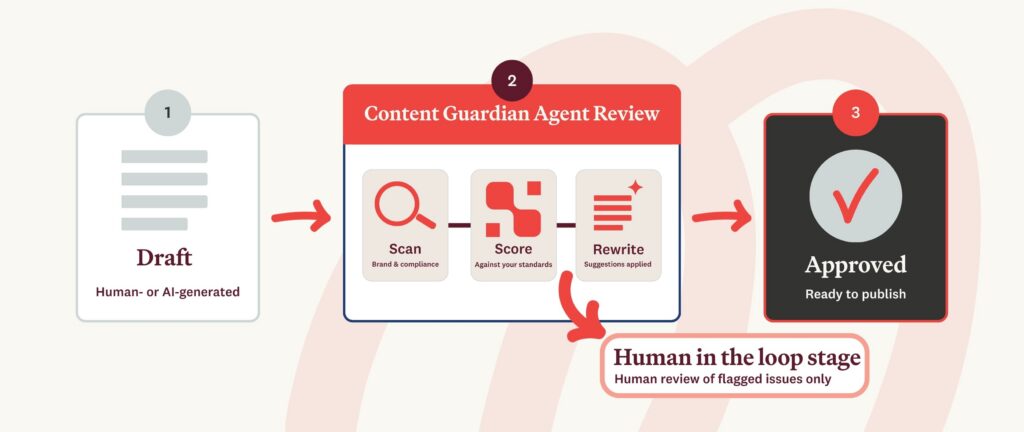
Real HITL is a workflow, not a rubber stamp. Technology does the first pass: it flags specific terminology issues, tone deviations, and policy risks against standards you’ve already defined. Only then does a human step in, and only to make the judgment call the system was built to escalate, not to reread content the system has already cleared. The result is a system where human expertise gets applied exactly where it adds value, instead of spread thin across every word of every draft.
Streamlining human review with automated guardrails
The mechanics matter more than the label. What actually changes the reviewer’s day is intelligent pre-screening: an automated layer that scores content for tone, terminology, and clarity before a human ever opens the document. Instead of hunting for problems across a full draft, your reviewer goes straight to the three sentences that need a second look.
This is what Markup AI’s Content Guardian Agents℠ do. They scan every asset against your specific brand, terminology, and compliance criteria, score it, and generate rewrite suggestions in real time. Your reviewer isn’t starting from a blank read-through. They’re starting from a prioritized list of exactly what needs attention, with a suggested fix already on the table. That’s the difference between reviewing everything and reviewing what matters.
By the numbers: why enterprises are building human oversight into AI workflows
- 45% of marketers believe AI models can adequately check their own work, yet 80% of their teams still perform manual reviews anyway. The behavior contradicts the belief.
- 99% of C-suite leaders say dedicated, independent content guardrails would be valuable for managing and validating AI-generated output.
- Passive, ad hoc review can’t keep pace once AI content volume multiplies past what a human team can read line by line.
Integrating HITL into your existing workflows
For developers and content ops teams, the question isn’t whether human in the loop AI is a good idea. It’s whether adopting it means tearing out the tools your team already relies on. It shouldn’t.
A true HITL methodology has to fit inside the systems where content already gets created and published, whether that’s GitHub, Contentful, or a custom LLM deployment your team built in-house. Nobody wants a rip-and-replace IT project just to add a compliance layer. That’s why an API-native, MCP-ready approach matters: it lets the safety layer live invisibly inside your existing pipeline instead of forcing a new interface on your team.
Scaling trust without sacrificing velocity
Enterprises don’t have to choose between the speed AI gives them and the safety a compliance process demands. That’s a false trade-off built on the assumption that human review has to mean manual review. It doesn’t.
A smart HITL workflow, backed by automated scoring and rewrite suggestions, lets you scale content production with confidence instead of crossed fingers. Your team moves at AI speed. Your compliance and brand standards move with it, not behind it. That’s what compliance AI looks like in practice: not a gate that slows you down, but a system that lets you go faster with less risk.
Explore our developer documentation to see how an API-native approach automates compliance in your existing workflows.
Frequently Asked Questions (FAQs)
What is the difference between RLHF and human in the loop in AI?
Reinforcement learning from human feedback (RLHF) is a training-time technique: humans rate model outputs to fine-tune the underlying model itself, before it’s ever deployed. Human in the loop AI is a production-time workflow: humans review, correct, or approve individual pieces of content as they move through your publishing pipeline. RLHF shapes how the model behaves in general. HITL governs what actually gets published, asset by asset.
Who typically manages the human in the loop process for enterprise content?
It varies by organization, but the pattern is consistent: a content ops or editorial lead defines the brand, terminology, and compliance standards up front, and reviewers, often content marketing managers, subject matter experts, or legal and compliance teams for regulated content, handle the flagged items day to day. The system routes issues to the right person instead of routing everything to everyone.
How do automated guardrails handle industry-specific regulatory frameworks?
Automated guardrails encode your applicable regulatory requirements, such as financial disclosure rules or healthcare privacy standards, as configurable criteria inside the scoring engine. Content gets scanned and scored against the specific framework relevant to your industry, and standards update centrally as regulations change, so every future asset reflects the current rules automatically.
Last updated: July 24, 2026
Charlotte Baxter-Read
Continue reading

What Is Answer Engine Optimization (AEO) and Why It Matters in 2026
 •
September 18, 2026
•
September 18, 2026

What You Told Us About AI Slop at Drive 2026
 •
September 16, 2026
•
September 16, 2026
Markup AI Expands Its AI Content Editor to the Tools Marketing Teams Already Use
•
September 18, 2026