
Why Content Accuracy Is the Most Important Brand Safety Metric
 •
July 27, 2026
•
July 27, 2026

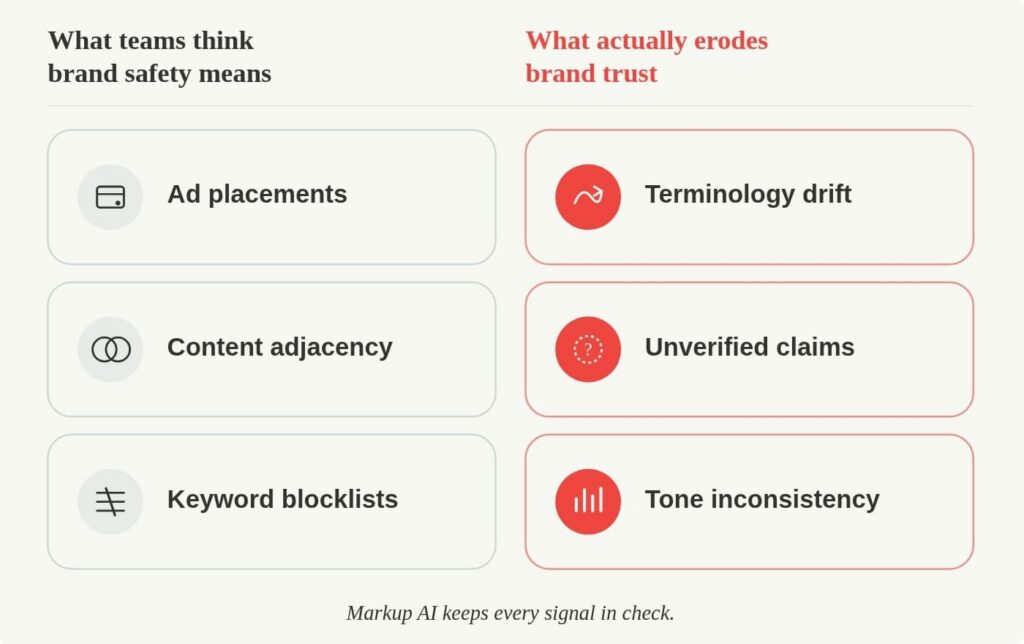
Modern enterprises publish across more departments, more regions, and more AI tools than ever before, and keeping all of it consistent has become nearly impossible to do manually. For years, brand safety meant avoiding offensive ad placements or a headline-making legal penalty. Today, the bigger threat comes from inside your own content: information that’s inaccurate, inconsistent, or quietly out of date.
Key takeaways:
- Most organizations think of brand safety as a filter, something that keeps bad content out.
- The bigger threat to your brand reputation isn’t where your content appears. It’s whether the content your team publishes is actually accurate.
- Wrong product names, inconsistent terminology, unverified claims, and off-tone messaging erode customer trust more quietly, and more permanently, than a misplaced ad placement ever could.
- Content accuracy is the brand safety metric hiding in plain sight, and it’s one a brand management platform can actually enforce at scale.
Your brand may have a content accuracy problem
A product launch blog post goes live with last year’s product name. A customer-facing FAQ still references a feature you deprecated two releases ago. A regional campaign makes a claim your legal team never actually approved.
None of this trips a compliance alarm. None of it results in a fine. But each one chips away at the confidence of a customer who noticed, and every noticing customer is one more person who quietly trusts your brand a little less.
This is what a content accuracy problem looks like in practice: not a single dramatic failure, but a slow accumulation of small ones, spread across hundreds of assets and dozens of contributors, that never shows up as a single line on a report.
What content accuracy actually means (and why it’s hard to maintain)
Content accuracy isn’t a grammar check. It’s a multi-layered standard, and every layer has to hold for content to actually be accurate:
- Correct product names and approved terminology
- Consistent brand voice and editorial style
- Factual claims that are verifiable and current
- Messaging that reflects your current positioning, not last quarter’s
When one team produces your content, holding that standard is manageable. One editor can keep the full picture in their head. But most large organizations aren’t running one content team. Marketing, product, sales enablement, customer support, and technical documentation are all publishing at once, often with AI tools accelerating how fast each of them can ship. The gap between what your brand says and what it actually means to say grows every time one more team, or one more AI tool, joins the publishing pipeline.
The pain point looks different depending on your seat. For technical writers managing documentation across multiple product lines, a single inconsistent product name can cascade across hundreds of pages before anyone notices. For marketers, an unverified performance claim can sit live on a landing page for months, quietly working against the trust the rest of your content is trying to build.
Inaccurate content doesn’t just look bad, it costs you trust
Trust is a compounding asset, and it compounds in both directions. A customer who catches one error doesn’t just discount that piece of content. They discount your brand’s overall competence. In high-stakes sectors like healthcare or finance, an inaccurate claim can be the last thing a prospective customer reads before they choose a competitor instead.
AI-generated content raises the stakes here rather than lowering them. AI makes it easy to publish more, faster, but it makes it just as easy to publish the wrong product name, inconsistent terminology, or off-brand language at the same scale and speed. The moment that output needs heavy manual review to catch those errors, the speed advantage AI was supposed to deliver disappears. This effect compounds over time, too: as AI tools summarize, resurface, and cite your existing content, stale or inaccurate pages don’t just sit quietly in an archive. They keep getting recirculated, and that’s called context rot.
The cost is invisible until it isn’t. Unlike a regulatory fine, trust erosion from inaccurate content doesn’t show up as one line item. It shows up gradually, in lower conversion rates, higher support ticket volume, and slower sales cycles where buyers feel uncertain about what you actually offer.
Why traditional brand safety tools don’t solve this
If your team already invests in brand safety tooling, ad verification platforms, content adjacency checks, keyword blocklists, that’s a real and worthwhile investment. It’s also solving a different problem than the one described above.
External brand safety tools ask one question: is this a safe environment for our ad to appear in? Content accuracy governance asks a different one entirely: is our own content safe to publish? The gap between those two questions is where most organizations are exposed. They’ve protected their brand from third-party content risk while leaving their own content creation workflows, where accuracy and consistency actually break down day to day, largely unmonitored.
That’s not a criticism of external brand safety tools. It’s a reminder that they were never built to answer the question that matters most once your own team is the one publishing at volume.
What real content accuracy governance looks like
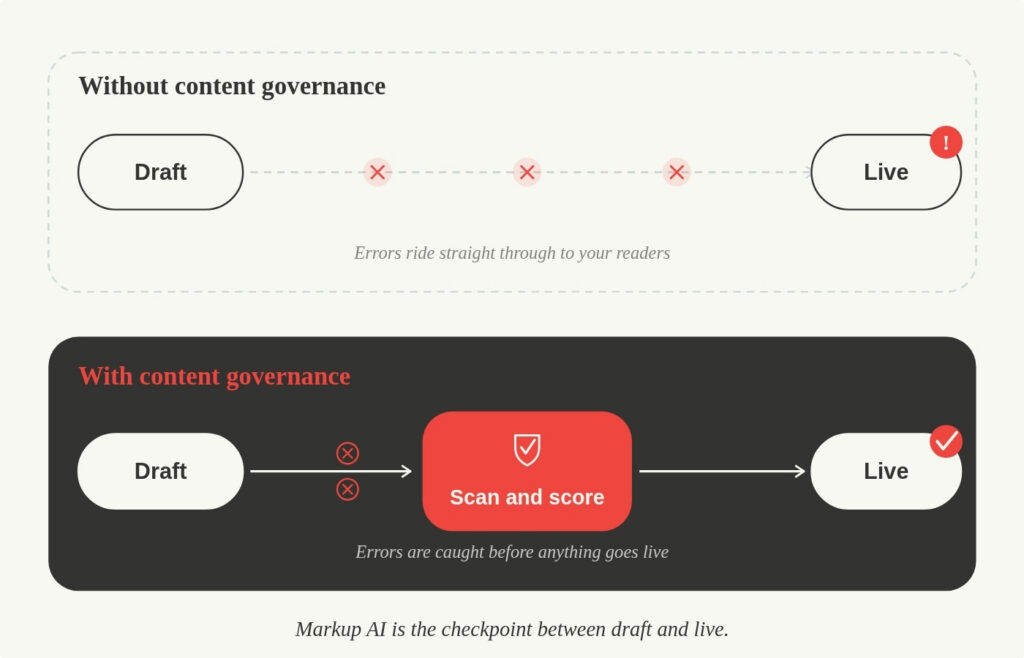
Closing this gap requires a different category of tool entirely: one built to check your own content before it goes live, not just the environment around someone else’s.
An effective content accuracy governance system should:
- Check content against your approved terminology and brand standards before it publishes.
- Work across every content format: marketing copy, technical documentation, blog posts, and social.
- Integrate into the workflows you already use, your CMS, your CCMS, your writing tools, so it doesn’t add friction.
- Provide quality scores that make accuracy measurable, not just a subjective judgment call.
This is the shift from ad hoc editorial practice to a true brand management platform: one where accuracy checks aren’t a final gate or an occasional manual review, but something embedded directly in the content workflow itself, catching issues in real time instead of after the fact.
Content accuracy is a brand reputation decision
This isn’t a compliance conversation or a technical one. It’s a strategic one. Every piece of inaccurate content that ships is a small trust withdrawal. Accumulated over hundreds of assets, thousands of pages, and months of AI-assisted publishing, those withdrawals add up to something your brand feels, even if no single report ever names it.
Organizations that treat content accuracy as a measurable, governable standard, rather than a best-effort editorial practice, are the ones building brand reputations that hold up under real scrutiny. Content accuracy isn’t just the most overlooked brand safety metric. In an era where AI is generating content at scale, it’s becoming the most important one.
How Markup AI’s Content Integrity Agents enforce content accuracy at scale
This is exactly the problem Markup AI’s Content Guardian Agents℠ were built to solve. Within the suite, Content Integrity Agents focus specifically on the accuracy layer: verifying claims, flagging unsupported statements, and catching the kind of stale or unverifiable statistic that quietly undermines a piece of content long after it’s published.
They don’t work alone. The Brand Guardian Agent suite backs them up with a dedicated Terminology Agent that keeps product names and approved vocabulary consistent, a Consistency Agent that enforces editorial style and brand conventions, a Tone Agent that aligns every message with your brand voice and audience, a Clarity Agent that removes jargon and improves comprehension, and a Spelling and Grammar Agent that delivers foundational accuracy across everything you publish. Together, they turn “accuracy” from a single fuzzy standard into several measurable ones.
For organizations in regulated industries, Compliance Guardian Agents extend that same real-time enforcement to required phrases, disclaimers, and warnings. And because AI search tools increasingly summarize and cite brand content directly, AI Visibility Guardian Agents help make sure what gets surfaced about your brand is as accurate as what you originally published.
All of it runs where your content already gets created, so accuracy becomes part of your publishing workflow instead of a separate review step someone has to remember to run.
See how Markup AI’s Content Guardian Agents keep your content accurate at scale. Let’s talk!
Frequently Asked Questions (FAQs)
What’s content accuracy, and why does it matter for brands?
Content accuracy means every piece of published content, from a product page to a technical document, correctly represents your brand’s approved terminology, claims, style, and voice. It matters because inaccurate content erodes customer trust, creates inconsistent brand experiences, and in regulated industries, can expose your organization to legal risk. At scale, it’s one of the most consequential and least monitored brand safety risks you have.
What’s the difference between content accuracy and brand safety?
Traditional brand safety focuses on external risk: making sure your brand isn’t associated with harmful or inappropriate third-party content, particularly in media buying. Content accuracy is an internal discipline. It’s about making sure the content your brand produces and publishes is itself accurate, consistent, and trustworthy. Both matter, and each requires different tools and processes.
How do large organizations maintain content accuracy at scale?
Manual review doesn’t scale. Organizations producing high volumes of content, across marketing, product documentation, and customer communications, need automated governance built directly into their content workflows: tools that check content against brand standards, terminology guidelines, and compliance requirements before it publishes, not after.
Can AI-generated content be accurate?
Yes, but not automatically. AI tools can produce content quickly, but they don’t inherently know your approved product names, your brand voice, or your compliance requirements. Without a governance layer checking AI-generated content against your brand standards, AI actually increases the risk of publishing inaccurate content at scale. A brand management platform with automated accuracy checks is what makes AI-assisted content production trustworthy.
What’s a brand management platform, and how does it help with content accuracy?
A brand management platform is software that helps organizations define, enforce, and monitor brand standards across all their content. The best platforms go beyond storing guidelines. They actively scan and score content in real time, flagging issues before they reach customers. Markup AI’s Content Guardian Agents are one example: they check content for terminology consistency, tone alignment, claim accuracy, and compliance requirements across every workflow.
What types of content errors damage brand reputation most?
The errors that cause the most trust damage are usually the quietest: wrong product names, inconsistent terminology, unverified performance claims, outdated statistics, and messaging that doesn’t match your current brand positioning. None of these trigger alarms. They just make customers quietly less confident in your brand’s reliability and expertise.
Last updated: July 27, 2026
Charlotte Baxter-Read
Continue reading

What Is Answer Engine Optimization (AEO) and Why It Matters in 2026
 •
September 18, 2026
•
September 18, 2026

What You Told Us About AI Slop at Drive 2026
 •
September 16, 2026
•
September 16, 2026
Markup AI Expands Its AI Content Editor to the Tools Marketing Teams Already Use
•
September 18, 2026