
The Content Control Maturity Model: Where Does Your Organization Stand?
 •
June 10, 2026
•
June 10, 2026

Key takeaways:
- Content control capability evolves through five levels, from reactive and manual to fully automated and optimizing.
- Most organizations are at Level 1 or 2: reactive, inconsistent, and increasingly exposed as AI adoption grows.
- Knowing where you are is the prerequisite to knowing where to invest.
- The gap between Level 2 and Level 4 represents the difference between content as a liability and content as a scalable competitive advantage.
- Progress doesn’t require starting over. It requires systematically addressing the gaps between where you are and where you need to be.
Every organization has some level of content control capability. The question isn’t whether you have standards, it’s whether those standards are enforced, consistently, at the volume you’re now producing.
Most marketing teams are scaling AI content faster than at any point in marketing history. Content marketing at scale with AI is now within reach for teams of nearly any size. Most are also running quality control processes designed for a world where production was slower, AI wasn’t in the workflow, and a small team could realistically review everything before it went live.
That world is gone.
The content control maturity model describes five levels of evolution — from reactive, manual oversight to fully automated, continuously improving readiness. Understanding where your organization sits today is the prerequisite to knowing where to invest next. And for most marketing leaders, the honest answer to “where are we?” is more humbling than expected.
Level 1: Reactive
At Level 1, content control is an afterthought. There are no systematic standards. Quality review is informal, inconsistent, and triggered only when something goes visibly wrong.
The typical experience at Level 1: errors get caught after publication. Compliance issues are escalated after the fact. Brand voice is whatever the writer on a given day thought sounded right. Rework is frequent, expensive, and reactive.
Most organizations don’t stay at Level 1 intentionally. They arrive there because control was never prioritized as AI adoption scaled. The publication volume outpaced the oversight infrastructure — gradually, then suddenly.
The risk at Level 1 isn’t static. Every piece of content that reaches audiences without passing through any standard contributes to a growing pattern of inconsistency that compounds over time.

Level 2: Documented but not enforced
At Level 2, standards exist — a style guide, a brand voice document, a set of messaging guidelines — but they live in documents that not everyone reads, can’t be consistently applied across tools and contributors, and aren’t monitored for compliance.
This is the most common position for mid-market organizations with growing AI content programs. Standards are aspirational. Enforcement relies on individual judgment and goodwill. And as volume increases, the gap between what’s in the document and what gets published widens.
Level 2 feels safer than Level 1 because standards exist on paper. It isn’t. An unenforced standard doesn’t protect brand consistency or reduce compliance risk, it just creates the appearance of oversight without the substance of it.
The particular danger of Level 2 in a high-volume AI environment is that it creates false confidence. Leaders believe standards are in place. Teams believe they’re following them. But the actual published output tells a different story.
Level 3: Systematic but manual
Level 3 organizations have moved beyond documentation into systematic review — structured checklists, defined approval workflows, designated reviewers. Standards are actually applied, not just written down.
The challenge at Level 3 is scale. Systematic manual review works when content volume is manageable. When AI accelerates production, review capacity becomes the bottleneck. Important checks get skipped. Cycles slow down. Consistency suffers under volume pressure.
Level 3 is a meaningful improvement over Level 2, but it isn’t a sustainable operating model for organizations scaling content marketing with AI. The more AI is adopted, the more the Level 3 review process constrains the benefit. Teams end up in a difficult position: either slow production to match review capacity, or accept that the review process will increasingly become a formality rather than a genuine quality gate.
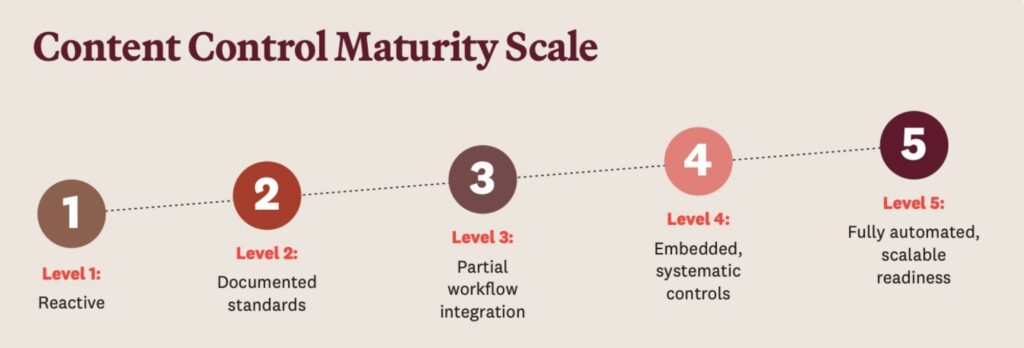
Level 4: Automated and embedded
Level 4 is where content control becomes a genuine competitive advantage.
At Level 4, quality gates are embedded directly into the tools and workflows where content is created. Automated checks evaluate content against brand, accuracy, compliance, and optimization standards at the point of creation. Human review focuses on judgment calls — the decisions that require strategic, contextual expertise — rather than routine quality checks that take time but don’t require human judgment.
The result at Level 4 is transformative. Content readiness scales with production. Volume increases don’t degrade quality. Rework rates drop significantly. Compliance incidents decrease. The content team spends more time on strategy, creative direction, and audience-building and less time on copy QA, error correction, and reactive remediation.
This is where the organizations leading in AI content marketing at scale are operating. They’ve made the systems investment that allows them to capture the full productivity benefit of AI without absorbing the quality and compliance risk that uncontrolled AI production creates.
Level 5: Optimizing and predictive
Level 5 organizations have moved beyond enforcement into continuous improvement.
Content control systems at Level 5 generate performance data — readiness rates, issue frequencies, review cycle times, rework rates by content type and channel — that feeds back into the standards themselves. The system doesn’t just enforce quality; it generates insight into where quality is failing and why.
At Level 5, the content control system learns. Standards are updated based on what’s working. New risk categories are identified proactively before they manifest in published content. The gap between what’s published and what should be published shrinks continuously, rather than requiring periodic audits to identify where it has grown.
Level 5 is the mature state of content marketing at scale with AI, where AI is fully deployed as a force multiplier, quality is consistently enforced, and the organization is using its own content performance data to continuously raise the standard.
Where are most organizations today?
Honestly? Level 1 or 2.
The acceleration of AI content adoption has outpaced the investment in control infrastructure at most organizations. Teams are producing more, faster, with more contributors and more tools, and running the same review processes they used three years ago, when production was a fraction of the current volume.
The risk isn’t static. As AI adoption increases, the exposure at Level 1 or 2 compounds. More volume means more opportunities for brand drift, accuracy failures, and compliance gaps to accumulate. The organizations that don’t invest in moving up the maturity curve now will face more expensive remediation later.
How to move up the maturity curve
The path from Level 1 or 2 to Level 5 isn’t a single project. It’s a structured progression.
Start with an honest audit of where content is being created, what standards currently apply, and where failures most frequently occur. Map every content creation workflow across teams, tools, and vendors. Identify where AI-generated content enters the process. Document existing review and approval processes. Identify the most common quality failure points: brand drift, accuracy errors, compliance gaps.
Then define specific, enforceable standards across all four control layers: brand, accuracy, compliance, and optimization. These should be criteria-based, not aspirational. “On brand” is a standard only when it’s defined specifically enough to be evaluated consistently.
Embed those controls into the tools and workflows where content is created. The further downstream a quality gate sits, the less effective it is. Controls at the point of creation prevent the problem. Controls at the end of the process catch the problem, but only the ones that reviewers have time to find.
Automate the systematic elements. The checks that are rules-based and consistent — brand terminology, formatting standards, required disclosures, structural optimization requirements — should be automated. Reserve human review for the judgment calls that require strategic expertise.
Finally, introduce metrics. Content readiness rate, issue rate, review cycle time, rework rate. Track them consistently and use them to drive continuous improvement. What gets measured gets managed.
The organizations that invest in this progression now will have a structural advantage when AI content volume continues to scale — and it will.
Get the complete five-step implementation guide for moving up the maturity curve. Download The CMO’s Playbook for AI Content Control →
Frequently Asked Questions (FAQs)
How do you assess which level your organization is at?
The honest starting point is an audit: map all content creation workflows, identify where AI-generated content enters the process, document existing review and approval processes, and identify where quality failures most frequently occur. The pattern of failures will tell you where enforcement is actually breaking down — and which level most accurately describes your current state.
Is it possible to skip levels — for example, jump from Level 2 to Level 4?
Yes, especially with the right technology. Organizations that invest in automated enforcement before building out extensive manual review processes often progress from Level 2 to Level 4 faster than those who go through Level 3 first. The key is getting the standards defined clearly before automating enforcement — you need to know what you’re enforcing before you can automate the enforcement.
What’s the ROI of moving from Level 2 to Level 4?
The ROI case is built on reduced rework, faster review cycles, lower compliance incident rates, and improved content performance. The hidden cost of reactive content control — rework, remediation, reputational damage — is consistently underestimated. Organizations that quantify their current rework burden typically find a compelling ROI case for automated enforcement at Level 4.
Last updated: June 10, 2026
Charlotte Baxter-Read
Continue reading

What Is Answer Engine Optimization (AEO) and Why It Matters in 2026
 •
September 18, 2026
•
September 18, 2026

What You Told Us About AI Slop at Drive 2026
 •
September 16, 2026
•
September 16, 2026

Markup AI Expands Its AI Content Editor to the Tools Marketing Teams Already Use
•
September 18, 2026