
Winning the AI Search Era With AI Visibility Guardian Agents
 •
August 17, 2026
•
August 17, 2026

Key takeaways:
- Search behavior has fundamentally changed, shifting from keyword-based link indexing to AI engine retrieval models like Perplexity and Google AI Overviews.
- LLMs prioritize content that features high factual density, clear structural formatting, and absolute brand consistency.
- AI Visibility guardian agents scan, score, and structure your content so generative search engines can cite it with confidence.
- Teams can implement these optimization guardrails directly into their existing workflows via API, ensuring AI visibility without adding manual review steps.
Standard SEO used to guarantee a shot at digital real estate. A well-optimized page, a healthy backlink profile, and the right keyword density were enough to earn a spot on page one. That guarantee no longer holds. Search is shifting from a list of blue links toward AI engine retrieval. Enterprise content that isn’t built for that shift risks going unseen by the LLMs now answering user queries directly.
Our AI Visibility agents were specifically designed to help marketers meet the changing editorial needs of today’s AEO, GEO, and SEO best practices. These agents act as the bridge between your enterprise content and the generative engines actively synthesizing answers for your buyers.
The shift from standard SEO to AI retrieval
Generative engines don’t evaluate content the way legacy search crawlers do. Traditional crawlers index pages and rank them by relevance signals like keyword density and backlinks. Generative engines work differently: they use Retrieval-Augmented Generation, or RAG, to pull structured, factual, easily extractable data out of your content and synthesize it into a direct answer, often with a citation, often without sending the reader to your site at all.
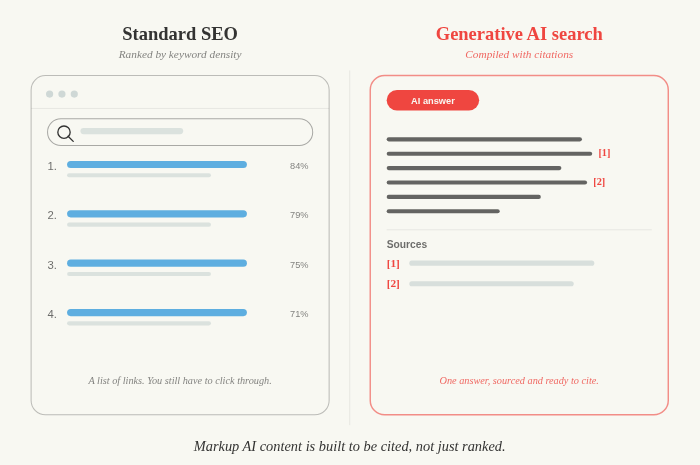
That means writing a genuinely good post is no longer enough on its own. The content also has to be architected so an LLM can read it, extract it, and cite it with confidence. The AI Visibility agents closes the gap between content that’s well-written and content that’s actually retrievable. This is why we’ve positioned it as one of the top solutions for AI visibility and generative engine optimization.
Industry benchmark: AI Overviews now appear on 88% of informational queries in Google Search. When one appears, click-through rates to traditional organic listings drop by 61%. Only 8% of users click through to a website at all (WordStream; Seer Interactive, 2026). Digital real estate hasn’t disappeared. It’s moved inside the answer itself.
This shift doesn’t remove the need for human judgment. AI can restructure and extract, but it still takes a person with real expertise to decide what’s worth saying in the first place, a balance we explore further in how AI and humans partner in content production.
Structuring content for LLM citation with AI Visibility agents
AI Visibility agents scans every draft the way a generative engine would, checking whether the content is actually structured for extraction, not just readable to a human. In practice, the agent enforces structural clarity across several dimensions. Definitions are concise and appear early rather than buried in a paragraph. Statistics are clearly formatted and attributed rather than embedded in dense prose. Headings directly address user intent instead of relying on clever or vague phrasing.
It functions as an automated editor, tuning every asset specifically to be favored by AI retrieval systems, on top of the brand, accuracy, and compliance checks the rest of the Content Guardian Agents℠ suite already performs.
Industry benchmark: Structure measurably affects citation rates. Articles of 2,900 words or more average 5.1 AI citations, and content broken into 120- to 180-word sections between headings sees a 70% boost in citation likelihood compared to long, unbroken passages (Stackmatix, 2026). The Visibility Guardian checks for exactly this kind of extractable structure before an asset ever publishes.
Future-proof your organic traffic strategy
Putting these agents to work in an enterprise doesn’t require an overhaul of its tech stack. AI Visibility agents, like the rest of the Content Guardian Agents suite, live directly inside the workflows where your content is already created, your CMS, your git-based documentation pipeline, or your custom LLM deployment.
That’s a deliberate design choice. Enterprises adapting to the AI search revolution shouldn’t have to adopt a new interface or add a manual review stage to get there. The same automated layer that closes the content trust gap for brand voice and compliance, covered in more depth in our piece on automating AI regulatory compliance, now extends to AI visibility, scoring and structuring content for generative engines seamlessly, right where your team already works.
See exactly how our new agent ensures your brand gets cited in AI search results. Explore AI Visibility Guardian Agents.
Frequently Asked Questions (FAQs)
What’s generative engine optimization (GEO)?
Generative engine optimization is the practice of structuring content so AI-powered search tools, like ChatGPT, Perplexity, and Google AI Overviews, can extract, synthesize, and cite it in generated answers. Unlike traditional SEO, which optimizes for ranking in a list of links, GEO optimizes for being the source a generative engine actually pulls from and credits.
How does Perplexity choose which sources to cite?
Perplexity and similar retrieval-based engines favor sources with clear factual density, well-structured data (like defined terms, formatted statistics, and direct answers near the top of a page), and established topical authority. Content that’s easy to extract, meaning it states its point plainly rather than burying it in narrative prose, is significantly more likely to be pulled into a generated answer and cited than content that reads well but resists extraction.
Does structuring content for AI search harm traditional SEO?
No. The structural elements that improve AI citation, clear headings, concise definitions, well-formatted data, and direct answers to user intent, are the same qualities traditional search crawlers reward for readability and relevance. Optimizing for generative engines and optimizing for traditional search are complementary practices, not competing ones, since both ultimately reward clear, well-organized, authoritative content.
Last updated: August 17, 2026
Continue reading

Brand Voice Drift: What It Is and How to Catch It Early
 •
October 13, 2026
•
October 13, 2026

AI Made Content Faster. It Shouldn’t Make “Good Enough” the Standard.
•
October 9, 2026

AEO and GEO Best Practices: How to Become the Source AI Actually Cites
•
October 6, 2026