The hybrid workforce: Moving from the “Wild West” to strategic AI orchestration
 •
December 22, 2025
•
December 22, 2025
For the last five years, the corporate world has been locked in a singular, often exhausting debate about the definition of “hybrid work.” We have argued over days in the office versus days at home. We have measured commute times, analyzed Zoom fatigue, and rewritten policies on remote flexibility. But while we were busy looking at the where of work, a far more profound revolution was quietly rewriting the who of work of the hybrid workforce.
The old definition of hybrid work is obsolete. The new definition has nothing to do with your physical location.
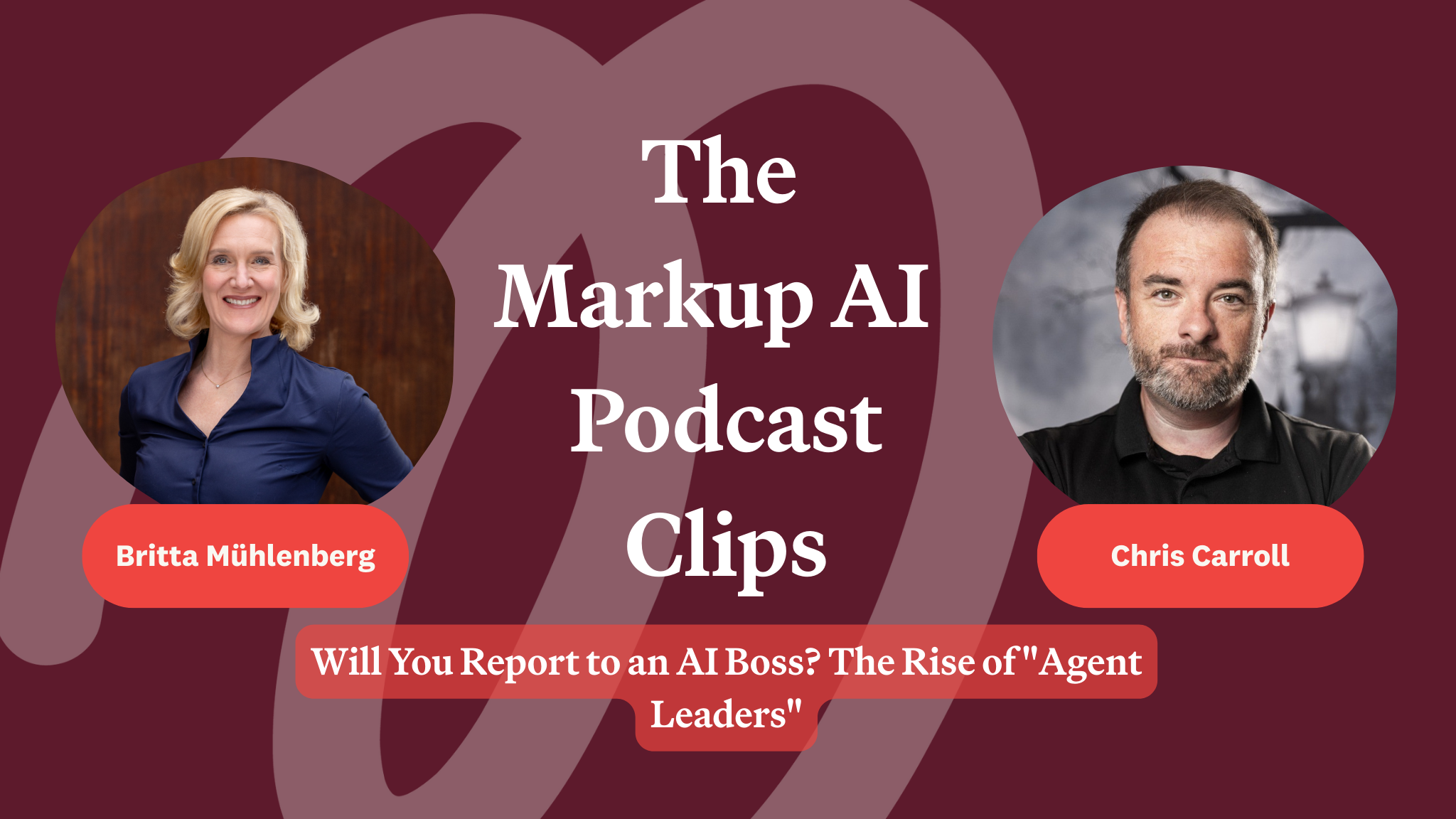
As Britta Muhlenberg, Chief Operating Officer at Markup AI, recently articulated on the Markup AI Podcast, we are witnessing the dawn of a true Hybrid Workforce. This is an ecosystem where the “hybrid” nature is defined by the seamless integration of human intelligence and AI orchestration.
This isn’t just about using new tools. It is about a fundamental restructuring of the organizational chart. Companies that grasp this shift will evolve into agile, high-velocity powerhouses. Those that cling to the old ways, paralyzed by fear or skepticism, risk becoming the “laggards” of the next industrial era.
Key takeaways
- Redefining hybrid: The conversation is no longer about location; it is about the collaboration between human employees and silicon colleagues (agents).
- Three modes of interaction: Future operations will rely on Human-to-Agent, Agent-to-Agent, and Human-to-Human workflows working in tandem.
- Governance enables speed: To move from the “Wild West” of isolated AI use to a scalable workforce, you need guardrails that enforce consistency and safety.
- The manager mindset: Humans must shift from being “doers” to being “managers” of agentic workflows.
The end of the “Wild West”
To understand the magnitude of this shift, we must first look at where we are coming from. Muhlenberg notes that we are currently transitioning out of the “Wild West” phase of AI adoption.
Until recently, AI usage in the enterprise was characterized by scattered experimentation. Individual employees used ChatGPT on the side to draft emails, developers used distinct copilots to write code, and rogue departments spun up isolated bots. It was chaotic, unmeasured, and often risky.
The dawn of the hybrid workforce marks the mature phase. It is the move from “little fires everywhere” to a centralized, governed, and strategic engine. It is the realization that AI agents are not just productivity boosters for individuals; they are a scalable labor force that requires management, governance, and culture just like their human counterparts.
This transition transforms AI from a linear tool—like a spell-checker that waits passively for a command—into a workforce. In this new AI orchestration dynamic , the agent is a colleague. It has a role, a set of responsibilities, and a degree of autonomy to perceive, reason, and act.
The three modes of AI orchestration
In her vision of the future, Muhlenberg outlines a ecosystem defined by three distinct layers of interaction. Understanding these layers is critical for any leader trying to build an operational strategy for the next decade.
1. Humans and agents (The co-pilot era and beyond)
This is the most visible layer of the hybrid workforce. It is the interaction between a human employee and their digital counterparts. However, as we move toward agentic workflows, the nature of this relationship changes fundamentally.
In the past, the human spent 80% of their time doing the work and 20% reviewing it. In the hybrid workforce, the human acts more like a manager. You define the outcome, provide the context, and unleash the agent.
The human role: To provide intent, context, and ethical oversight. The agent role: To execute, iterate, and present options.
For example, consider a technical documentation lead. Instead of writing API documentation line by line, they instruct a “Documentation Agent” to scan the codebase, extract the relevant endpoints, and draft the documentation adhering to the company’s specific style guide. The agent executes the heavy lifting. The human reviews the output for accuracy and nuance.
This shifts the required skill set for your human teams. The value lies less in rote execution and more in “prompt engineering” (giving clear instructions) and “output evaluation” (knowing what good looks like).
2. Agents and agents (The silent workforce)
This is the layer that will drive the most explosive gains in productivity, yet it is the one least understood by the general public. Muhlenberg alludes to a future where we have this AI orchestration of “agents and agents interacting.”
Imagine a complex customer service scenario in a financial services company. A “Triage Agent” receives a support ticket regarding a loan application.
- It analyzes the sentiment and technical complexity.
- Instead of forwarding it to a human, it pings a “Diagnostic Agent” to check the server logs for errors during the application process.
- Simultaneously, it triggers a “Compliance Agent” to check if the customer’s financial data meets current regulatory standards.
These three agents communicate, share data, and resolve the issue in milliseconds without human intervention. This “Agent-to-Agent” interaction creates a subterranean layer of productivity that runs 24/7. It allows businesses to scale operations without linearly scaling headcount, breaking the traditional link between revenue growth and overhead costs.
3. Humans and humans (The premium interaction)
Paradoxically, as AI agents take over execution and data synthesis, human-to-human interaction becomes more valuable, not less.
In a hybrid workforce, humans are freed from the drudgery of rote tasks—the data entry, the scheduling tetris, the initial drafting. This liberates them to focus on the things agents cannot do: complex negotiation, empathetic leadership, creative breakthrough, and ethical judgment.
When humans interact in this new world, they aren’t meeting to update spreadsheets; they are meeting to decide strategy. The hybrid workforce doesn’t replace humans; it elevates them to the top of the cognitive value chain.
The provocative future: Agents as leaders?
Perhaps the most fascinating prediction Muhlenberg makes is the shift in hierarchy. We are comfortable with the idea of humans leading agents. We are less comfortable with the reverse.
“There will be agent leaders,” Muhlenberg suggests. “Humans will lead agents, but potentially even agents leading humans.”
What does it mean for an agent to “lead” a human? It sounds dystopian, summoning images of robot overlords, but in a practical business context, it is simply “algorithmic management”—and it is already here.
Consider the ride-share driver. They have a human manager somewhere, but their minute-to-minute work—where to go, who to pick up, which route to take—is directed by an algorithm. That is an AI orchestration of agents leading a human.
In the white-collar world, this might look like a Project Management Agent. This agent could:
- Analyze the workloads of five designers.
- Identify who has capacity.
- Assign a task to a human designer with a due date.
- Follow up automatically if the deadline is at risk.
In this scenario, the agent performs the administrative overhead of leadership (scheduling, resource allocation, tracking). This frees up the human leader to focus on mentorship, career development, and vision—the parts of leadership that actually require a human soul.
The great divide: Innovators vs. laggards

The transition to this hybrid workforce will not be uniform. We will see a split between those who “lean in” and the “laggards.”
The laggards are defined by fear. They worry about data privacy, they worry about hallucinations, and they worry about losing control. This fear leads to paralysis. These companies will continue to operate with high friction, paying humans to do work that competitors are automating for pennies. Their response times will be slower, their overhead higher, and their ability to innovate stifled by manual processes.
On the other side are the companies building Hybrid Workforces. They are not reckless; they are strategic. They understand that the risks of AI are management challenges to be solved, not reasons to abstain.
Governance is the bridge to the future
This is where the concept of “Guardrails” becomes essential in the AI orchestration landscape. You cannot build a hybrid workforce if you do not trust your agents. If you are constantly worried that your “Marketing Agent” will hallucinate a fact or your “Support Agent” will use the wrong tone with a client, you will never unleash them fully.
This is why Content Guardian Agents℠ are the critical infrastructure of the hybrid workforce.
Innovators solve the trust problem by wrapping their AI agents in governance. They use Markup AI to automatically:
- Scan every piece of content generated by an agent (or a human).
- Score it against enterprise standards for brand voice, terminology, and compliance.
- Rewrite issues instantly before the content ever reaches a customer.
By solving the governance problem, these companies unlock speed. They treat guardrails as enablers, not blockers. This allows them to scale their hybrid workforce with confidence, knowing that every agent is aligned with the company’s standards.
Preparing for the shift
The dawn of the hybrid workforce is not something to be feared. It is an invitation to reimagine what an organization can be. It is a chance to strip away the drudgery of modern work and hand it over to a workforce that never sleeps.
But you cannot just flip a switch. You must prepare your organization for this new reality.
- Audit for agent potential: Stop looking for simple scripts to automate. Look for roles to augment. Find workflows that require a mix of data retrieval, reasoning, and output.
- Establish governance first: Do not wait for a disaster. Integrate Markup AI to ensure your agents are creating content that is safe, on-brand, and accurate.
- Upskill for agent leadership: Teach your managers how to manage silicon employees. This includes prompt engineering and rigorous output evaluation.
- Connect your agents: Look for bottlenecks where humans are acting as “copy-paste” bridges between systems. These are prime candidates for agent-to-agent automation.
The divide is coming. On one side, the laggards, clinging to the manual workflows of the 2010s. On the other, the hybrid pioneers, orchestrating a symphony of human and machine intelligence. Which side of the divide will you stand on?
Frequently asked questions
What is the difference between “automation” and the “hybrid workforce”? Automation generally refers to software performing repetitive, single-function tasks (like sending a receipt). The hybrid workforce involves AI agents that have a degree of autonomy. They can perceive context, reason through problems, and make decisions to achieve a goal, acting more like a colleague than a simple tool.
Will AI agents replace human jobs? The goal of the hybrid workforce is augmentation, not replacement. By offloading data synthesis, routine drafting, and administrative overhead to agents, humans are elevated to higher-value roles. Humans focus on strategy, creative breakthroughs, and empathetic leadership—tasks that agents cannot perform.
How do we ensure AI agents don’t make mistakes or go “rogue”? Trust is established through governance. You must implement guardrails that monitor agent output. Markup AI uses Content Guardian Agents℠ to scan, score, and rewrite agent-generated content, ensuring it meets your compliance, legal, and brand standards before it is published.
What does “Agent-to-Agent” interaction look like in practice? This occurs when multiple AI agents collaborate to solve a problem without human intervention. For example, a Triage Agent might classify a customer issue and instantly pass it to a Technical Support Agent to run diagnostics, while a Billing Agent checks the account status. The agents share data and resolve the complex workflow instantly.
How can I start building a hybrid workforce today? Start by auditing your workflows for bottlenecks where humans are doing “robotic” work. Then, ensure you have a governance layer in place. Once you have a way to enforce quality and safety (like Markup AI), you can begin deploying agents to handle those workflows with confidence.
Last updated: December 22, 2025
Christopher Carroll
Continue reading


Going Beyond the Chatbot: How to Operationalize AI Content Creation
 •
March 31, 2026
•
March 31, 2026

The Hidden AI Content Risks (And How to Fix Them)
•
March 26, 2026
Get early access. Join other early adopters
Deploy your Brand Guardian Agent in minutes.