
Improve Communication with Strategic Terminology Management
 • January 9, 2026
Key takeaways:
- Terminology is critical for clarity, consistency, and legal compliance.
- Inconsistent terms slow projects and confuse customers.
- Early terminology definition improves content quality across teams.
- Governance and accessible tools help enforce correct usage.
- Strong terminology management supports better user experiences worldwide.
What does terminology mean to you? Why does your organization need it, let alone a process to manage it? For global companies that target international markets, the need for clear and consistent terminology is now more important than ever. And for many of the world’s greatest brands, consistent terminology isn’t just about keeping terminology on brand — it’s often a prerequisite for legally compliant content.
One thing’s for sure. If you’re waiting to deal with terminology until your content reaches translation, it’s too late. Inconsistent terminology in your content has negative consequences for your business. Poor terminology management causes:
- Delays in projects and product launches
- Inconsistent internal and external communication
- Misunderstandings in translation and localization
- Dissatisfied customers
In this post, we introduce the concept of terminology and explain why it’s relevant to nearly every industry. Whether it’s product development or marketing, we all use specific terminology to talk about our products, services, and processes.
Why is consistent terminology important?
Pop quiz! What would you call these clothing items in the image below? It’s not a trick question, promise. (Hint: The answer isn’t “jeans”!)

Would you call these “pants”? Or was your first thought “trousers”?
This often depends on where you were born or which variety of English you learned. For non‑native speakers, it can be surprising to learn that the same word may mean different things to different people. In the UK, for example, “pants” typically refers to clothing worn underneath “trousers.”
If everyday words can cause confusion, imagine the impact in technical fields where concepts are more specialized. Customers are usually less familiar with your products than you are. Using consistent terminology across channels improves readability and makes instructions, manuals, and product descriptions easier to find, read, and understand.
It’s also common to write content for multiple audiences. Some readers expect technical detail, while others prefer simplified explanations. Terminology plays a key role in making content clear for all of them.
The concept of terminology
Let’s get to the nitty-gritty and talk about linguistic theories. If it wasn’t your favorite topic back at university, know that it’s still useful for content creation.
The Merriam-Webster dictionary defines terminology as:
- “the technical or special terms used in a business, art, science, or special subject”
- “nomenclature as a field of study”
Considering the narrower context of companies, we use the word terminology to mean the words and phrases that your company uses. That might be the approved messaging you use to describe your brand, the name and different parts of your product, or the way you describe your services.
So, on the one hand, terminology refers to the actual words or terms and on the other, it’s also a science focusing on the creation and meaning of those terms. In an enterprise setting, you’ll follow a similar process. First, you’ll have to come up with a name for your product, feature, or service, and then you’ll have to define what it means and when to use it.
But back to terminology as a broader concept. Linguists have long pondered over the relationship between the meaning and representation of words. Let’s continue and take a look at some of the most notable theories.
Semiotics is a field of linguistic studies that started way back with Aristotle and Plato, continuing later with Saussure. Linguistic experts like them concentrated on the general patterns and functions that any language can show. In short, a graphical or physical representation symbolizes a concept of reality.
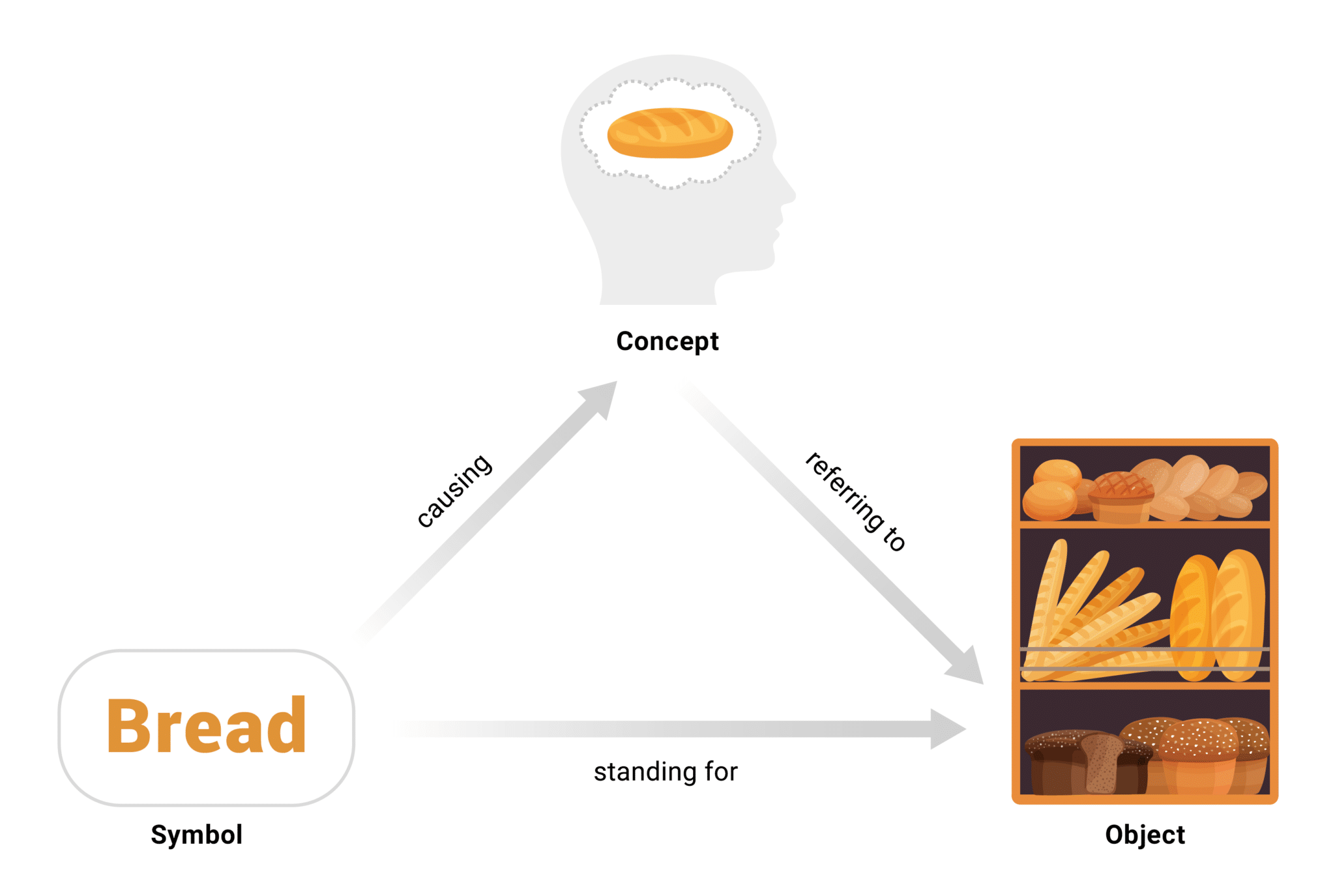
This train of thought was advanced by Odgens and Richard. They created the Semiotic Triangle, also known as Triangle of Reference. In this theory, there are three components:
- The graphical representation or a symbol (a.k.a. the word)
- The object or the referent (the thing we refer to in the real world)
- The thought or reference (the mental concept)
This mental concept allows us to categorize an individual object by comparing it to other references. Even though we’ve never seen that specific object before, most of the time we’re able to name it because we’ve seen something similar.
Still confused? Let’s use an easy example to clearly demonstrate the Semiotic Triangle. We’ll use something that everyone knows in one form or another: bread. Maybe you’ve been on vacation and found new, delicious types in the local bakeries. And still, you would identify it as “bread.”
If you’d like to learn more about semantics, this e-lecture is worth a look: Juergen Handke, linguistic professor at the Marburg University gives an introduction to semantics and helps with understanding the Semiotic Triangle.
You might wonder how we differentiate between different concepts. Remember that we mentioned definitions before? Let’s revisit them.
By defining a word, we try to create a description. One that’s so broad it includes all versions, past, present, or future. It’s also important that the definition can’t explain a word by using the same words. A front door is the door at the front of a house. Not a helpful definition, right?
Defining objects or actions can prove quite difficult, take a table for example. Would you include the number of legs a table has? Most of us would probably say it’s four. But there are also tables with only one leg in the middle and a flat round foot, or tables that are mounted to a wall. But these are called wall-mounted folding tables — and they’re simply a subcategory of tables.
So as we saw, definitions are tricky. But for now, we’ll stick to the basics.
Effective terminology management in practice
Whew, that was a lot of abstract theory. So, how can we put this theory into practice? And also make use of it when creating our content?
Analyze existing terminology
The easiest way to gather words — to start a nomenclature — would be to create a list. This can even be in a normal text document. No high-tech required. This way, you create a simple glossary with a collection of terms. You might even want to add a definition or explain a term.
But what even qualifies as a term? A term is any word or phrase that:
- Represents your brand
- Is frequently used
- Is used in customer communications
- Changes over time
- Has negative consequences if used incorrectly
If you have a list of terms, with explanations of how and when to use each term, that’s called a lexicon. A lexicon is different to a printed dictionary or an online version, because it captures your own subject, industry, and enterprise specific use of certain words. Compared to a simple glossary list, a lexicon provides you with far more information like:
- Company specific definitions
- Grammatical number or gender (if it exists in your language)
- Antonyms and synonyms
- Collocations or frequent word combinations
- Notes on how or when to use the term in different contexts
Also, you don’t have to work with just a list of words, sorted alphabetically. Another option for a terminology database is a semantic network. This and other graphic representations can be helpful to make sense of the relationship between terms.
Creating and managing such a terminology database is usually the job of a terminologist. Note that we said “usually.” Everyone can start collecting terms they have trouble understanding or differentiating from other terms.
Set the spelling rules
Creating spelling rules for an enterprise terminology database is essential for keeping clarity, consistency, and efficiency in translation and localization.
To start, select a base dictionary to work from (E.g Oxford for British English or Merriam-Webster for American English) that your terminology guidelines will follow. Determine if you want region-specific variations of spelling depending on your target audience, and make sure you cover things like hyphenation rules, and how to handle acronyms like (E.g U.S vs. US).
For proprietary terms, product names, and brand names, make sure you define exactly how these should be spelled and used in different contexts. If you content will be translated, it’s good to consider how to adapt technical or branded terms into non-English languages.
Start a terminology database
Are you a technical expert? Or a content creator in the marketing department? Then, creating a terminology database makes perfect sense for you.
As we’ve said before, don’t wait too long to deal with terminology. It consists of those special words and phrases that are specific to your company, brand, and the products or services you offer. Without even knowing it, you already have this terminology in every piece of content. Sometimes you use terms more densely and other times more technically. And if you haven’t defined them clearly, or used them consistently, your customers will struggle to understand your content.
In an ideal world (and every terminologists’ dream), the recommended approach would look something like this: You’d start developing a terminology database during the product research phase or in early stage product development. While conceptualizing a new product, content creators will have access to a database of clearly defined terminology and all of the information that goes with it.
When you take care of terminology in this early stage, it’s essential to consider legal issues, and how to keep your content compliant. Think of another company holding the trademark for a term, or the word itself reminds most people of that one competing company. (Imagine you’ve created a sweet breakfast spread from hazelnuts, you’d like to stand apart from Nutella®!)
Define the processes
Part of good terminology management means defining clear processes. Provide training to make sure employees know the spelling rules and how to use your terminology database. Where possible, integrate this guidance wherever writers create content, to make it easy to get the terminology correct from the beginning without needing to research the terms. You’ll need to regularly review and update spelling and language as business needs evolve, so creating a terminology council and a governance process to review and approve new terminology is also a good idea.
Ensure company-wide terminology awareness
The best way to enforce consistent terminology across the enterprise is to ensure everyone is aware of the importance of terminology and make it easy to apply the correct terminology wherever people write. A centralized terminology guide, preferably one that’s not locked in a spreadsheet or company intranet is recommended. Terminology management software is best, especially when it integrates with employees daily tools, connects to your terminology database, and can offer real-time feedback and enforcement of correct terminology usage.
And today, there are plenty of tools available to help that can do this. One of them is Markup AI. We offer Content Guardian Agents that give you the infrastructure to manage your terminology. It keeps all of your enterprise content aligned to the terminology that communicate your brand and its products or services.
A better user experience — In all content types & languages
So, let’s recap. First, you need to clearly define the legal and technical aspects connected to your terminology. Then, all your other departments can build their content based on this guidance. The result is that your technical documentation uses the correct terminology consistently throughout your content. As a result, any piece of your content is easy for everyone to understand and it results in usable products and happy customers.
Did we manage to convince you about the importance of terminology in technical product documentation? Great! But what about marketing? Is there such a thing as marketing terminology? Of course.
Consistent terminology is important to deliver prospects and customers a smooth buyer journey and build trust in your brand. When it comes to search engine optimization, certain keywords become essential terminology.
And for you as a marketing content creator, there’s an even more relevant aspect: It’s important that your entire company uses the same terminology when talking to customers or prospects. This means that the prospect has a chance to become familiar with your products and services. Different terms for the same thing would just confuse the customer. But when you use consistent terminology through every step of the customer journey, you increase customer satisfaction and loyalty.
Lower legal risk, clear customer content, and an overall good user experience. By now, you’re probably convinced that these aspects are worth the effort to invest in better terminology management across your enterprise.
Strong terminology management makes your editing process much shorter and more efficient, whether you’re creating (high-quality) content in-house or with agencies. You’ll also receive fewer questions and queries from freelancers when the content is sent off for translation and localization. This produces huge cost savings. And finally, you’ll be able to communicate your brand identity in one clear voice. Even in another language.
Putting terminology management into practice
Hopefully, we’ve highlighted for you the importance of taking care of your company’s terminology. Want to know more? Let’s talk to see how Markup AI can help your company keep terminology consistent.
Frequently Asked Questions (FAQs)
What’s terminology management?
Terminology management is the practice of defining, standardizing, and governing the terms an organization uses across content, products, and communications.
Why is consistent terminology important for global companies?
It reduces misunderstandings in translation, supports compliance, and ensures customers receive clear and consistent messaging across regions.
When should organizations start managing terminology?
Ideally during product research or early development, before content is created at scale.
How does terminology management improve content quality?
It improves readability, reduces editing time, lowers translation costs, and helps maintain a consistent brand voice.
Last updated: May 5, 2026

Charlotte Baxter-Read
Continue reading

Say Goodbye to Robot Prose With Content Integrity Agents
 • August 27, 2026
Markup AI Shortlisted in The 2026 A.I. Awards
• August 25, 2026