Who Should Steer the Enterprise AI Strategy in Your Company?
 •
December 17, 2025
•
December 17, 2025
Key takeaways
- AI is a business mandate, not just an IT project. While IT ensures security and stability, business units must define the strategy and destination.
- Guardrails enable speed. The best technical leadership provides the infrastructure for teams to experiment safely, rather than acting as a bottleneck.
- Empower “bilingual” talent. Enterprise AI strategy success requires team members who understand both domain expertise and technical capabilities.
- Buy over build. To maintain velocity, prioritize flexible integrations over massive, slow-moving custom internal builds.
In the modern business landscape, a critical question is taking center stage: Who is actually in charge of your Enterprise AI strategy?
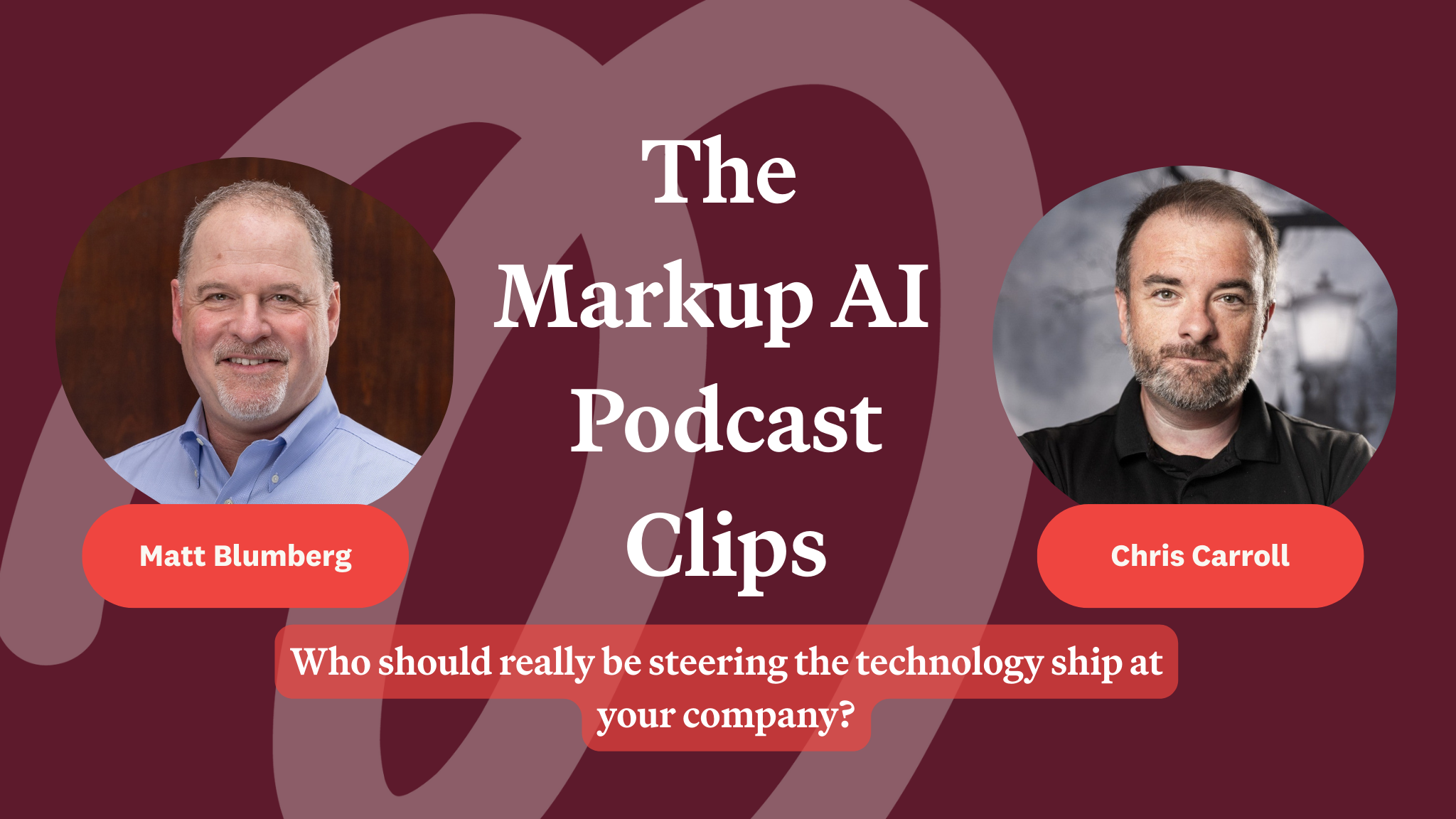
We saw this friction during the dot-com boom and the mobile revolution. Now, we see it with the rise of Artificial Intelligence. In a recent episode of the Markup AI Podcast, Matt Blumberg shared his thoughts on the fundamental challenges of AI distribution and how it isn’t just choosing the right Large Language Model (LLM) or integrating new software. It’s a structural question about leadership, ownership, and how technology serves your business goals.
When transformative technology enters the scene, the instinct is to hand the keys to the IT department. On the surface, this feels logical — AI involves code, data, and servers. But treating AI solely as an IT project is a recipe for stagnation. To succeed, you must ensure the people steering the ship are the ones who know the destination.
The lesson from mobile
The current shift echoes the mobile revolution. Back then, the sudden ubiquity of smartphones forced businesses to scramble. The initial reaction was to silo these initiatives within technical teams.
However, the companies that won the mobile era didn’t just have the most sophisticated code. They were the organizations where marketing, sales, and product teams understood how mobile changed their relationship with the customer. They used technology to solve business problems, not just to display technical prowess.
We are at the same crossroads with AI. It’s easy to get lost in the “how” — training models, managing latency, and securing data. While these are critical, they are foundational. The strategic question is “why.” What friction are you removing for the customer? What new value are you creating?
Your CIO or CTO can’t answer those questions alone. Business leaders who are in the trenches with the market every day must provide the answers.
The driver’s seat dilemma of enterprise AI strategy
The core friction point in many organizations is the “Driver’s Seat Dilemma.”
Traditionally, the IT department holds the keys to the infrastructure. They are the guardians of security, stability, and scalability. This is a vital role. You don’t want a marketing manager spinning up unsecured servers that leak customer data. However, there’s a distinct difference between building the car and driving it.
When IT departments become the sole drivers of AI strategy, you risk:
- Solving the wrong problems: Technical teams are incentivized to build robust systems. Without business alignment, they may spend months perfecting an AI tool that doesn’t fit the end-user’s workflow.
- Bottlenecks: Centralizing all AI initiatives creates a “request and wait” culture. This kills speed to market.
- Slow velocity: Business units need to iterate quickly. Traditional IT governance, designed for stability, often acts as a brake on necessary experimentation.
The goal isn’t to cut IT out of the loop. The goal is to redefine the relationship. Business units (Sales, HR, Operations, Marketing) must sit in the driver’s seat to set the destination and pace of enterprise AI strategy. IT acts as the navigator and mechanic, ensuring the vehicle is safe, fueled, and capable of the journey.
Two types of technical leadership
To navigate this transition, you need to assess your technical leadership style. Broadly speaking, IT leaders fall into two camps regarding innovation.
1. The gatekeeper
This leader views AI as territory to control. Their primary instinct is centralization. While this creates control, it creates bottlenecks. In an era where speed is life, this command-and-control style becomes a major liability.
2. The empathetic enabler
This is the leader companies need right now. They understand their role is to serve the business. They ask, “What is the sales team struggling with?” They view AI as a utility to empower others. They let other departments experiment with AI tools by providing guardrails rather than roadblocks.
Democratization and the end of the “tech gatekeeper”
One of the most profound shifts AI brings is lower technical barriers. Ten years ago, building a predictive model required a team of PhDs. Today, a marketing manager can use off-the-shelf AI tools to analyze sentiment or generate copy.
This democratization shifts the power dynamic. Forward-thinking organizations are establishing “citizen developer” programs. They teach accountants, marketers, and logistics managers how to prompt AI and leverage data.
This moves the organization from a “request and wait” model to a “self-serve” model. IT builds the platform and governance rules, but the business units build the solutions they need.
Your five year survival guide
If you accept that AI integration is inevitable, you need an enterprise AI strategy playbook to handle it.
Audit your steering committee
Look at who makes decisions about AI investment. If it’s 100% technical staff, you have a problem. Your steering committee must include the heads of revenue, customer success, and product. The people responsible for the P&L should decide where the technology applies.
Shift IT KPIs
If you measure IT solely on uptime and security, they will optimize for risk aversion. Change the incentives. Measure IT leaders on “internal velocity” — how fast are they enabling other teams to ship? When IT shares business goals, the friction dissolves.
Foster “bilingual” talent
The most valuable employees are “bilinguals” — people who understand domain expertise (like supply chain logistics) and speak the language of AI. Hire and train for this profile. These translators bridge the gap between business needs and technical capabilities.
Avoid the custom build trap
With AI evolving so fast, IT teams often want to build custom solutions that become obsolete in six months. The “empathetic enabler” knows when to buy versus build. For most use cases, a nimble SaaS solution that integrates with existing workflows is better than a massive internal project.
The human element of hardware
Technology is a lever that multiplies force. But a lever needs a fulcrum, and it needs a hand to push it.
The “fulcrum” is your business strategy. The “hand” is your people. If you separate the technology from the people who understand the strategy, you lose momentum.
As we move deeper into the AI age, the companies that thrive will successfully bridge the gap between technologists and tacticians. They will be the organizations where IT acts as a guide, not a gatekeeper.
The technology will change. The models will get smarter. But the organizational challenge remains: How do you align your tools with your truth? The answer lies in ensuring that those who know the customer best are the ones holding the map and leading your enterprise AI strategy.
Last updated: December 17, 2025
Christopher Carroll
Continue reading
Thinking Too Small: Why Safe Spaces Are the Key to Enterprise AI Adoption
•
December 22, 2025
The hybrid workforce: Moving from the “Wild West” to strategic AI orchestration
•
December 22, 2025
Get early access. Join other early adopters
Deploy your Brand Guardian Agent in minutes.