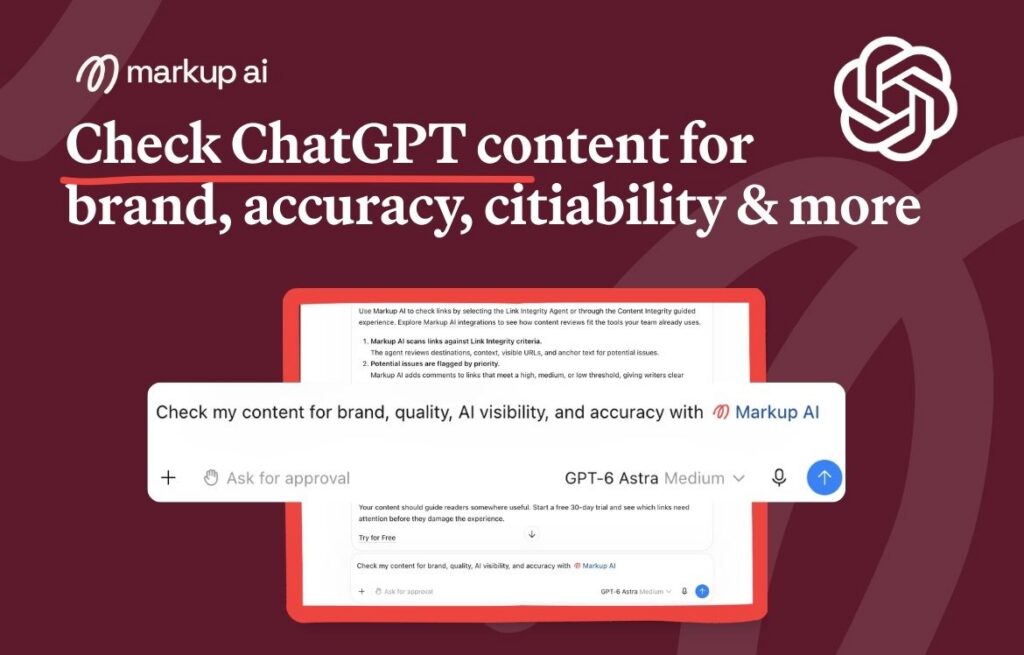
Create Content Guardrails that Actually Work
 •
November 20, 2025
•
November 20, 2025

Key takeaways:
- Static style guides are ineffective because they rely on flawed human memory, create editing bottlenecks, and are completely invisible to generative AI tools.
- Content guardrails act as digital bumpers, using machine-readable rules built directly into your workflows to actively scan, score, and correct messaging.
- Automated guardrails are essential for scaling safely, as they mitigate the risk of AI hallucinations and protect your brand’s reputation without overburdening human editors.
- Start by codifying your brand voice with clear examples, building a central terminology library, and mapping all compliance requirements.
- To make your guardrails work, you need to centralize them in a platform like Markup AI, where they can be made machine-readable and deployed everywhere.
What are content guardrails?
Content guardrails are the digital bumpers for your enterprise content. They are the programmable, machine-readable rules that actively monitor and correct your messaging as it’s being created. Unlike a static document that relies on human memory, guardrails live directly inside your workflows and AI tools.
With Markup AI, when a human types out a campaign or an AI drafts a blog post, Content Guardian Agents instantly scan the text, score it, and enforce your brand voice, approved terminology, and legal policies before anything goes live. Simply put: They’re the automated safety net that lets your team scale content production with total confidence.
Why are content guardrails important?
Picture this: a massive new campaign just went live, but the LLM you used to help draft the copy hallucinated a product feature you don’t actually offer. Or worse, a hurried writer accidentally included a promissory claim that puts you in hot water with your legal team. Panic ensues.
In the past, human editors could meticulously catch these slips because the volume of content was manageable. But let’s be real — those days are gone. Today, your team is expected to produce ten times the content across a dozen different channels, and you’re leaning on generative AI to make it happen. Human editors simply can’t scale fast enough to review every single word without becoming a massive bottleneck.
If you don’t have automated guardrails in place, scaling your content production is a massive risk. Guardrails are important because they shift the heavy lifting of brand consistency and legal compliance away from flawed human memory and onto a reliable, machine-readable system. They protect your brand’s reputation, keep you out of legal trouble, and give your creators the freedom to write faster, knowing the safety net will catch any mistakes before they ever reach your customers.
Disadvantages of static style guides
Your company probably has a well-crafted style guide. It’s a beautifully designed PDF that lives on a shared drive, outlining everything from your brand’s tone of voice to the proper use of the Oxford comma. But let’s be honest about its glaring flaws.
First, it relies entirely on human memory — how many people on your team actually reference that 40-page document every single day? Second, it’s completely disconnected from where the actual writing happens. And most importantly, static documents are completely invisible to your new generative AI tools. You can’t just hand a PDF to an LLM and expect perfect, ongoing compliance.
The truth is that static style guides are passive, hard to enforce consistently, and create massive editing bottlenecks. In an era of AI-powered content creation, your rules can’t just be written down; they need to be built into the very fabric of your content workflows. They need to be active, automated, and enforceable.
It’s time to turn your static document into dynamic, effective content guardrails. Here’s how.
Four steps for creating content guardrails
Step one: Codify your brand voice with examples
Defining your brand voice is more than just listing adjectives like “friendly” or “authoritative.” You need to translate those concepts into concrete, machine-readable rules.
Start by creating a list of “do this, not that” examples.
- Tone:
- Don’t say: “The platform offers automated content review features.” (Passive, weak)
- Do say: “Markup AI automates your content reviews.” (Active, confident)
- Word Choice:
- Don’t say: “utilize,” “leverage”
- Do say: “use”
- Personality:
- Don’t say: “We are pleased to inform you…” (Stuffy, formal)
- Do say: “We’re excited to share…” (Approachable, direct)
These examples provide clear patterns that a Content Guardian AgentSM can learn from and enforce automatically.
Step two: Build your central terminology library
Inconsistent terminology confuses customers and dilutes your brand. Is it “login,” “log in,” or “sign in”? Do you call them “users” or “customers”? And what is the exact, approved name of your latest product?
Create a single, authoritative glossary of all your key terms, including:
- Product and feature names
- Industry-specific acronyms
- Branded terms
- Technical specifications
This centralized library becomes the single source of truth for your entire organization and the foundation for a Content Guardian Agent that ensures perfect terminology every time.
Step three: Map your compliance needs
For many industries, this is the most critical step. Work directly with your legal and compliance teams to document every content requirement. This isn’t just about what you should say; it’s about what you must say and what you can never say.
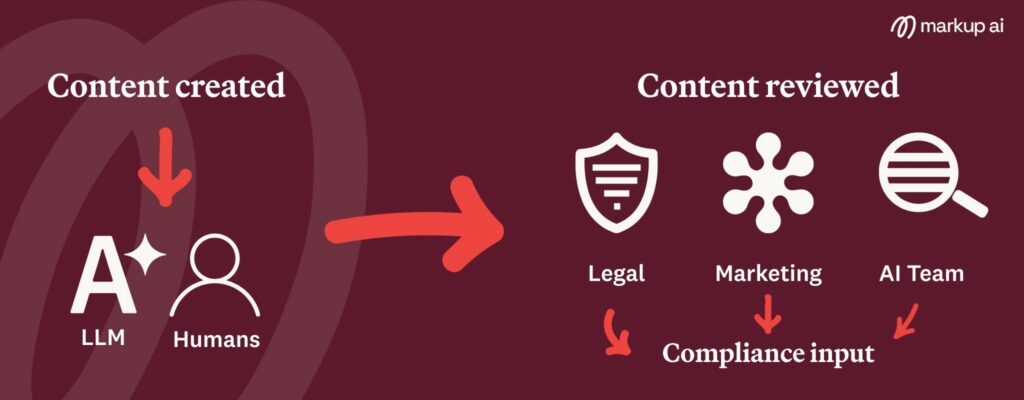
Your compliance guardrails should include:
- Mandatory disclosures: The fine print that must appear on all marketing materials.
- Forbidden claims: Promissory language like “guaranteed returns” or unapproved medical claims.
- Regulated terminology: Specific phrases required by governing bodies like the SEC or FDA.
Document these rules with zero ambiguity. They will form the most rigid and important layer of your AI content quality strategy.
Step four: Make your guardrails machine-readable
This is the step that turns your rules into action. A PDF on a server can’t do anything. To be effective, your guardrails must be centralized and structured in a way that software can understand and act upon.
This is where a platform like Markup AI is essential. Markup AI allows you to take all the rules you’ve defined — your brand voice examples, your terminology library, and your compliance mandates — and build them into a set of Content Guardian Agents.
By centralizing your guardrails, you create a single source of truth that can be deployed across all your tools and workflows. When you need to update a rule, you change it in one place, and the change is instantly reflected everywhere. Your guardrails are no longer a static document; they are a living, breathing part of your content ecosystem.
Ultimately, your guardrails are only as good as their enforcement.
Our new guide dives deep into how to turn your static rules into automated actions that accelerate your team and protect your brand. Download “The Definitive Guide to Content Guardian Agents” now.
Frequently Asked Questions (FAQs)
What if our brand voice changes?
That’s the benefit of a centralized platform. When your messaging evolves, you simply update the rules in your Content Guardian Agent, and the new voice is enforced immediately across all your content creation workflows.
How do we handle rules for different languages or regions?
Effective content governance platforms allow you to create different sets of guardrails for different contexts. You can have a core global brand voice, with specific variations for different languages, regions, or even product lines.
Can we integrate our existing style guide into a platform like Markup AI?
Absolutely. The first step in setting up Markup AI is to codify your existing style guide. Our team can help you translate your current rules into an automated, enforceable set of Content Guardian Agents.
How do we measure the success of content guardrails?
The success of content guardrails is measured directly through an automated risk-based score. When content is analyzed, an AI agent calculates this score by evaluating the text against specific, predefined business metrics: terminology consistency, editorial style, brand tone, clarity, grammatical accuracy, and strict adherence to policy and legal mandates.
Last updated: May 5, 2026
Charlotte Baxter-Read
Continue reading

“Unites States”: When Spellcheck Isn’t Enough
 •
October 2, 2026
•
October 2, 2026