
Balancing Practical Workflows, Content Governance, and Human Connection in an Agentic World
 •
January 8, 2026
•
January 8, 2026
“AI may or may not take your job, but somebody who knows AI better than you will likely take your job.”
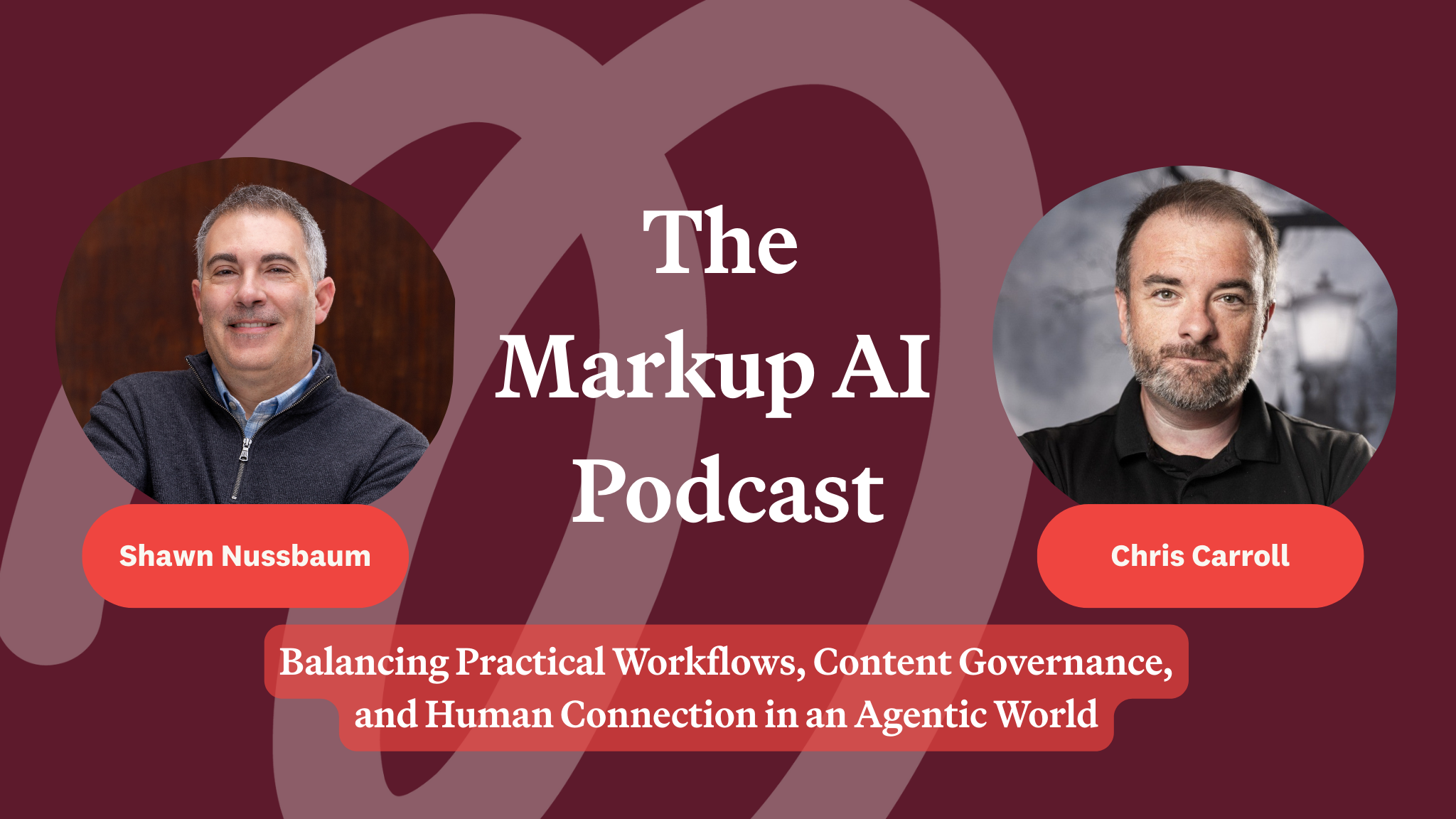
That was the sentiment shared by Shawn Nussbaum, our Chief Technology Officer here at Markup AI, during our latest podcast episode. It’s a phrase we hear variations of often, but when it comes from a CTO who is knee-deep in building the infrastructure of the future, it hits differently. It’s not a threat; it’s a reality check. It’s a call to move from passive observation to active orchestration in the world of AI generation and content governance.
I recently had the privilege of sitting down with Shawn to pry open his technical mind and get a unfiltered look at where generative AI is actually going—beyond the hype cycles and the LinkedIn buzzwords. We talked about everything from his personal “aha” moments to the rise of “agentic workflows” and why the next phase of the internet might not be built for human eyes at all.
If you missed the episode, I wanted to distill the conversation into a deep dive on the insights Shawn shared. We covered a lot of ground, but the overarching theme was clear: we are moving from a world of execution to a world of orchestration, and the businesses that survive will be the ones that prioritize clean data, content governance, and trust.
The Three Phases of Realization
I always like to ask guests when the reality of AI actually “clicked” for them. For many of us, it was the launch of ChatGPT in late 2022. But for Shawn, the realization came in waves, each more technical and profound than the last.
His first “aha” moment hit around 2020, working with vector embeddings and semantic search. He described the shift from simple keyword matching to true contextual awareness—where a machine could understand the difference between a “river bank” and a “bank account” simply by the company those words kept in a sentence. This was the precursor to the transformers that power the LLMs we use today.
The second wave was, predictably, the democratization of that power through chat interfaces. But his third realization is the most relevant to where we are right now: The coding revolution.
Shawn noted that with tools like Claude Code and Copilot, tasks that used to take months—like building a proof-of-concept web app—now take hours. This isn’t just about speed; it’s about the collapse of technical barriers. It allows technical leaders to iterate at the speed of thought. However, this power comes with a catch, which led us to one of the most practical analogies of the interview.
Content Governance: Managing Goal Drift
We’ve all heard about hallucinations—those moments when an AI confidently states a falsehood. Shawn pointed out that while hallucinations are getting better with post-training and search integration, the new challenge for businesses is “goal drift” or instruction-following errors.
This happens when you give a model a massive, complex prompt (a “one-shot” prompt) and it returns a result that ignores 40% of your instructions. It’s not that the model isn’t smart; it’s that it lacks the context of a seasoned professional.
Shawn treats LLMs like a brilliant intern: “They know I’m amazed at how much they know about Python… but they don’t have any real-world experience.”
This is a crucial reframing for anyone frustrated with AI outputs. If you ask an intern to “go build a marketing strategy,” they will likely fail. If you break it down—research competitors, draft three value propositions, outline a channel strategy—they will succeed.
The lesson here? Stop trying to force AI to be a senior leader. Use your experience to break complex problems into phased tasks. This is where the human moves from creator to orchestrator. You provide the guardrails and the wisdom; the AI provides the raw horsepower.
The Death of the “Middle” of SaaS
One of the more provocative topics we tackled was the idea that “SaaS is dead.” It’s a clickbait headline we see often, but Shawn provided the nuance that makes it terrifyingly real for software vendors.
Traditional SaaS products are usually three things:
- A user interface (UI).
- A database.
- Business logic in the middle (workflows, rules, processing).
Shawn argues that AI is effectively swallowing that middle layer. If you can use natural language to ask an AI to query your database and generate a report, do you need the complex, pre-baked report builder your SaaS vendor sells you? Maybe not.
This shifts the value proposition entirely. If the “logic” layer is commoditized by AI, the moat for businesses becomes clean data and content governance.
This is where the conversation turned toward what we do at Markup AI. As the volume of content explodes, the risk profile changes. Shawn noted that “increased volume leads to increased risk.” If you are generating content at scale, you can no longer rely on a static PDF style guide that no one reads. You need a living, breathing system that enforces rules automatically.
We need to stop thinking of brand guidelines as something writers must memorize, and start thinking of them as something AI enforces. This is the core of Content Guardian Agents. They scan, score, and rewrite content to ensure that even as you scale, you aren’t diluting your brand or inviting compliance risks.
The Agentic Future: From SEO to AIO
Perhaps the most forward-looking part of our chat was about the rise of autonomous agents. We are rapidly moving toward a world where humans aren’t the only ones browsing the web.
Imagine a future where you don’t book your own travel or order your own pizza. You tell your personal AI agent to do it. That agent goes out, navigates websites, negotiates with other agents, and executes the transaction.
Shawn posed a critical question for businesses: Is your content machine-readable?
Marketing has traditionally been about persuasion, emotion, and visual storytelling—things designed for human eyes. But if an AI agent is scanning your site to decide if your product fits its user’s needs, it doesn’t care about your hero image or your clever pun. It cares about intent and specification.
This suggests a massive pivot from Search Engine Optimization (SEO) to AI Optimization (AIO).
If your data isn’t clean, structured, and governed, you might be invisible to the agents of the future. Shawn highlighted that the “moat” for the next decade isn’t just having the best product; it’s having the best description of your product accessible via APIs and Machine Context Protocol (MCP).
If your organization’s content is messy, contradictory, or locked behind unstructured formats, you will be left behind when the agents come shopping.
The Trust Gap: Pragmatic Addicts
Despite the technical optimism, Shawn didn’t shy away from the societal friction we’re all feeling. He referenced a fascinating concept: the Utility-Trust Gap.
We are currently in a state where:
- Hundreds of millions of people use tools like ChatGPT weekly.
- Yet, nearly three-quarters of Americans believe AI will negatively impact their lives.
Shawn called us “pragmatic addicts.” We depend on a tool we don’t fully trust because we can’t get enough of the productivity it offers.
This manifests in the workplace as “AI imposter syndrome.” Professionals are stressed not just about doing their jobs, but about whether they are falling behind on the new way to do their jobs.
This is why implementation matters so much. Shawn observed that many Proof of Concepts (POCs) fail because companies try to do too much, too fast, with the most expensive models, without proper content governance. They get excited by the magic trick of a demo but fail to build the resilient infrastructure needed for scale.
The Human Element: What Can’t Be Replaced?
With all this talk of agents and automation, I had to ask: What is left for us?
Shawn’s answer was reassuring. AI can mimic tone. It can follow rules. It can even simulate empathy. But it doesn’t care. It has no lived experience. It has no values.
“People buy from people,” Shawn reminded us. The brands that win will be the ones that use AI to automate the draining, repetitive tasks—waiting on hold, scheduling meetings, data entry—so that humans can spend more time on connection.
If AI handles the transaction, the human handles the relationship.
In fact, Shawn suggested that as AI content becomes ubiquitous, human connection will become a premium asset. We might see a bifurcation where low-stakes interactions are fully automated, but high-stakes decisions—partnerships, complex sales, crisis management—become more human-centric than ever.
Key Takeaways
My conversation with Shawn reinforced that we are in a transitional period that is both messy and full of opportunity. Here is what I took away from our time together:
- Be the Orchestrator, Not Just the Executor: Treat AI like a talented intern. Give it context, break down tasks, and review its work. Do not expect it to lead; expect it to accelerate.
- Content Governance is the New Moat: As SaaS logic gets commoditized, your value lies in your data and your brand integrity. You cannot scale AI without guardrails. You need systems that automatically scan, score, and rewrite content to keep it aligned with your goals.
- Prepare for the Agentic Web: Your content strategy needs to evolve. It’s not just about convincing a human anymore; it’s about providing structured, clean data that an AI agent can ingest and act upon.
- Don’t Ignore the Fear: The anxiety around AI is real. As leaders, we need to acknowledge the “trust gap” and focus on AI as an enabler that removes drudgery, rather than a replacement for human value.
The pace at which this technology is moving is staggering. As I mentioned in the podcast, I used to spend eight hours editing an episode. With AI tools, that’s down to 90 minutes. That isn’t just “efficiency”—that is the difference between being able to produce this content and not being able to do it at all.
But speed without direction is just chaos. As Shawn pointed out, the goal isn’t just to go faster; it’s to scale with confidence.
At Markup AI, we are building the layer that makes that possible. We believe that you should be able to run fast with generative AI without breaking your brand or risking compliance violations. That is why we built Content Guardian Agents—to give you the freedom to innovate with the safety net of content governance.
If you are ready to move from experimenting with AI to orchestrating it at scale, you need to ensure your content foundation is solid.
Download our latest Thought Leadership Guide
Download The AI Trust Gap Report to learn how you can implement the strategies Shawn discussed and prepare your organization for the agentic future through content governance.
Last updated: January 8, 2026
Christopher Carroll
Continue reading


Going Beyond the Chatbot: How to Operationalize AI Content Creation
 •
March 31, 2026
•
March 31, 2026

The Hidden AI Content Risks (And How to Fix Them)
•
March 26, 2026
Get early access. Join other early adopters
Deploy your Brand Guardian Agent in minutes.