
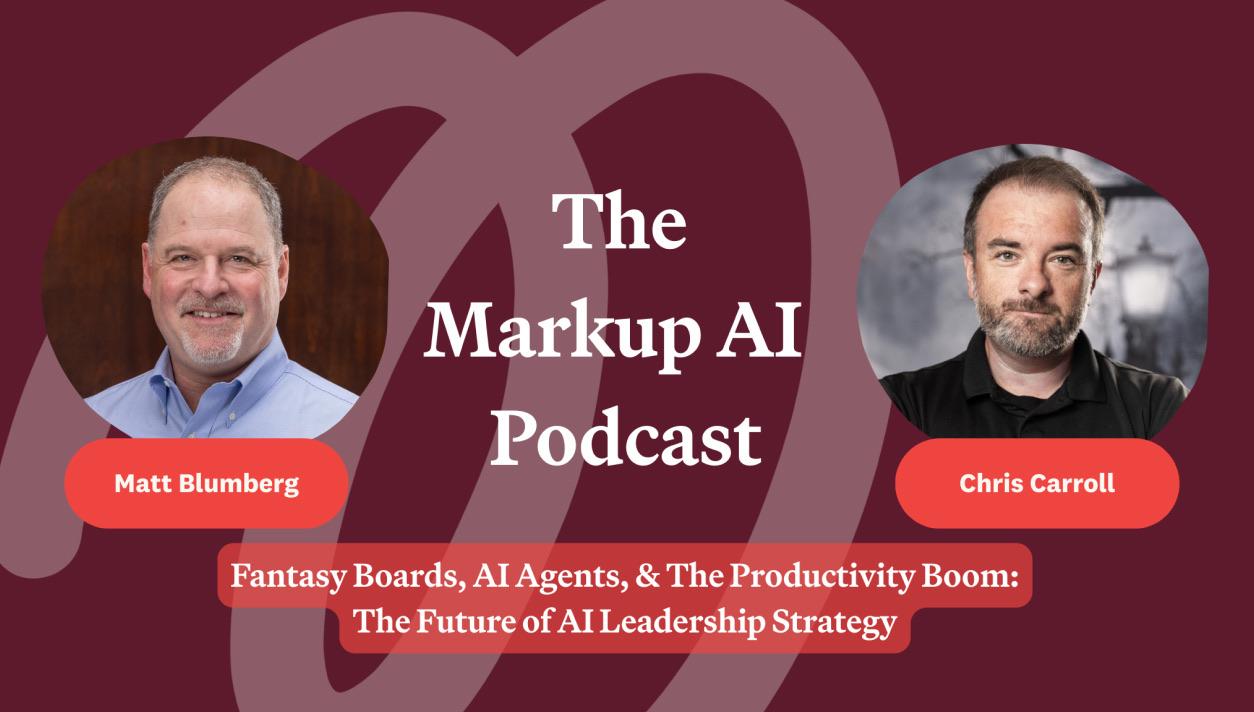
Fantasy Boards, AI Agents & The Productivity Boom: Matt Blumberg on the Future of AI Leadership Strategy
 •
April 8, 2026
•
April 8, 2026
Key takeaways
- Move beyond novelty: Real AI value isn’t in generating images, but in synthesizing complex data to make better decisions.
- The “previously unthinkable”: AI offers two types of value: ROI on existing tasks and the ability to do things that were previously impossible.
- Agentic workflows: Creating personalized agents, like a “Fantasy Board of Directors,” serve as powerful thought partners for leaders.
- The brand challenge: As AI interactions become more personalized, maintaining brand consistency requires automated guardrails.
- Ownership cycles: Organizations must ensure business owners, not just IT departments, remain in the driver’s seat of AI adoption.
We’re living through a fundamental shift in how business is conducted, content is created, and decisions are made. While the headlines often focus on the hype cycle — fluctuating between utopian promises and doom-scrolling predictions — leaders in the trenches are finding practical, transformative ways to leverage artificial intelligence right now.
In a recent episode of the Markup AI podcast, our CEO Matt Blumberg sat down to discuss the reality of AI leadership strategy and adoption. From personal “aha” moments to the rise of autonomous agents, the conversation revealed a roadmap for how professionals can navigate this disruption. Matt explores how we can move from simple automation to achieving the “previously unthinkable,” all while keeping humanity in the loop.
AI leadership strategy: The moment AI became real
For many, the introduction to generative AI was a parlor trick — asking an image generator to paint a cat in the style of Salvador Dalí or writing a limerick. While impressive, these use cases didn’t necessarily scream “business transformation.”
For Matt, the realization that AI was going to be a monumental shift came not from a creative prompt, but from a complex data problem. He shared a story about helping his daughter with a college transfer application. The task involved comparing her current school, three potential transfer schools, her resume, and her personal statements against a dozen key criteria that mattered to her.
“I wrote a monster prompt into deep research,” Matt explained. “I fed in my daughter’s resume, her personal statement… and I just said, ‘Go.’ I came back 15 minutes later to find a formatted 27-page PDF table comparing the schools.”
The result wasn’t just a time-saver; it was an analysis that likely never would have happened otherwise due to the sheer volume of manual labor required. This is the distinction between novelty and utility. It wasn’t just the Large Language Model (LLM) doing the work; it was the combination of predictive technology and deep research retrieval that delivered a material outcome.
The “previously unthinkable” vs. ROI
When businesses evaluate AI, they often look at it through the lens of traditional Return on Investment (ROI). They ask: What tasks is this automating, and how much money are we saving?
While valid, this view is limited. During the interview, Matt referenced a framework from Markup AI board member Jake Heller, which divides AI impact into two buckets:
- ROI: Efficiency gains on known tasks.
- The Previously Unthinkable: Things you never would have done because they were too expensive or impossible.
The college application story is a prime example of the latter. In a business context, this might look like a small company conducting a deep competitive market analysis that previously would have required hiring a top-tier management consultancy.
“I think the productivity impact that the world is going to see from AI is actually being understated,” Matt noted. The stock market has priced in productivity gains, but the potential for humanity to tackle problems that were previously out of reach — such as personalized pharmaceutical developments or hyper-specialized content scaling — suggests we are just scratching the surface.
Using AI agents as thought partners
One of the most compelling parts of the conversation revolved around the concept of “agents” — customized AI models designed to perform specific roles. Matt detailed two specific agents he has built to augment his own leadership capabilities.
1. The “MattBot”
Matt has written three books (Startup CEO, Startup CXO, Startup Boards), maintained a blog for 20 years, and hosted podcasts. He trained an agent on this massive body of work. Now, when asked for an interview or a written contribution, he uses “MattBot” to generate a 95% complete draft based on his own historical thinking and voice.
“I never take something from it and just hand it over,” Matt clarified. “But those things save me hours and hours.” This allows him to be more generous with his time, responding to requests he might otherwise have to decline.
2. The “Fantasy Board of Directors”
Perhaps the most innovative use case Matt shared was his “Fantasy Board.” He built an agent populated with business luminaries like Steve Jobs, Warren Buffett, and Clayton Christensen. By feeding the model thousands of words of deep research on how these individuals behaved specifically as board members, he created a synthetic sounding board.
“It’s effectively become a thought partner for me,” Matt said. “It’s way easier to ask the fantasy board for their opinion and get it back in a minute than it is to ask my real board to find time on the calendar.” While it doesn’t replace the context and governance of a real board, it provides immediate, diverse perspectives on strategic issues.
Brand consistency in an agentic world
As we move toward a world where AI generates content on the fly to deliver hyper-personalized experiences, a new challenge emerges: How do companies control their narrative?
If an AI agent is generating a customer service response or a marketing email in real-time, it might be tempted to “mirror” the user to get the best result. Matt discussed the tension between “mirroring” — adapting tone to match the customer — and staying “on brand.”
“If you’re on a sales call and the person leans back in their chair, you lean back,” Matt observed. “That’s not about you being on brand; that’s about you trying to get the best response.”
However, if every interaction is fluid, a brand can lose its identity. This is where Content Guardian Agents℠ become critical. Companies need a layer of technology that enforces non-negotiables — compliance, terminology, and core values — while allowing the AI enough flexibility to be effective.
Markup AI is built for this exact reality. We allow organizations to scan, score, and rewrite content instantly, ensuring that even as AI scales personalized communication, the core integrity of the brand remains intact.
The ownership cycle: IT vs. Business
A recurring risk Matt highlighted is the cycle of technology ownership. When a disruptive technology arrives — be it the internet, mobile, or now AI — ownership often shifts from the business unit to the IT department.
“The website became the property of the nerds,” Matt joked, referring to the early days of the internet. “Marketing was sort of at best co-equal.”
Eventually, technology becomes user-friendly enough that ownership reverts to the business lines. But in that interim period, friction occurs. IT teams may prioritize security or standardization over user experience and business agility.
“The biggest challenge that companies are going to have to deal with… is how to make sure that the people who are using the technology to drive the business forward are actually the ones in the driver’s seat,” Matt warned.
For AI to be successful, it can’t just be an IT project. It must be a business imperative owned by the leaders who understand the customer and the strategic goals.
What remains uniquely human?
With agents handling research, drafting content, and even simulating board meetings, what’s left for us?
Matt argues that while AI can simulate empathy or synthesize data, it can’t replicate the “creative application and mining of one’s life experience.” A bot might give you the right answer 90% of the time, but it lacks the nuance of human history, the biological synapses that fire to make unexpected connections, and genuine empathy.
“You can tell if another human is actually being empathetic toward you or if they’re faking it,” Matt said.
The future isn’t about agents replacing humans. It’s about a hybrid existence where routine and knowable tasks are handled by AI, allowing humans to focus on the spontaneous, the creative, and the deeply personal connections that drive real value.
As we navigate this shift, Markup AI is here to ensure that as you scale your use of these powerful technologies, you do so with confidence, clarity, and safety.
Frequently Asked Questions (FAQs)
What is the difference between ROI and the “previously unthinkable” in AI?
ROI focuses on efficiency — how much time or money AI saves on existing tasks. The “previously unthinkable” refers to new capabilities or projects that were previously too expensive or complex to attempt but are now possible through AI, such as deep personalized research or massive data synthesis.
How can leaders use AI agents today?
Leaders can build custom agents trained on their own data to assist with writing and scheduling. More advanced use cases include creating “persona” agents (like a fantasy board of directors) to stress-test ideas against different strategic viewpoints without needing to convene a meeting.
Will AI replace the need for brand guidelines?
No, it makes them more important. As AI generates more content dynamically, the risk of “hallucinating” or going off-brand increases. Tools like Markup AI and Content Guardian Agents are essential to scan, score, and rewrite AI-generated content to ensure it meets compliance and brand standards before it reaches the customer.
Why is IT ownership of AI a potential risk?
When IT departments strictly control AI adoption, they may prioritize technical implementation over business outcomes or user experience. Successful AI adoption requires business leaders (marketing, operations, HR) to be in the driver’s seat to ensure the technology actually solves business problems.
Last updated: April 8, 2026
Christopher Carroll
Continue reading




Get early access. Join other early adopters
Sign up for our priority access list to be notified of our latest updates and when you can start deploying Content Guardian Agents.