Is an AI Driven World a Sad Future? The Rise of “Premium Humanity”
 •
December 17, 2025
•
December 17, 2025
Key takeaways
- AI commoditizes the average: When everyone can generate code and copy instantly, human creativity and emotional nuance become the new gold standard in an AI driven world.
- The web is splitting: We’re moving toward a “Human Web” for emotional connection and an “Agent Web” for data processing.
- Automation requires a tiered approach: Successful companies will use AI for the baseline (speed and efficiency) and reserve human interaction as a premium “luxury” service.
- Guardrails enable the shift: To afford the “human premium,” businesses must use tools like Content Guardian Agents℠ to safely automate the trivial, allowing teams to focus on high-value interactions.
As we integrate AI into every facet of our lives — from debugging code to writing emails — a fundamental question arises: If machines can do everything in an AI driven world, what’s left for us? If we move toward a future where algorithms dictate our interactions, are we marching toward a sterile reality?
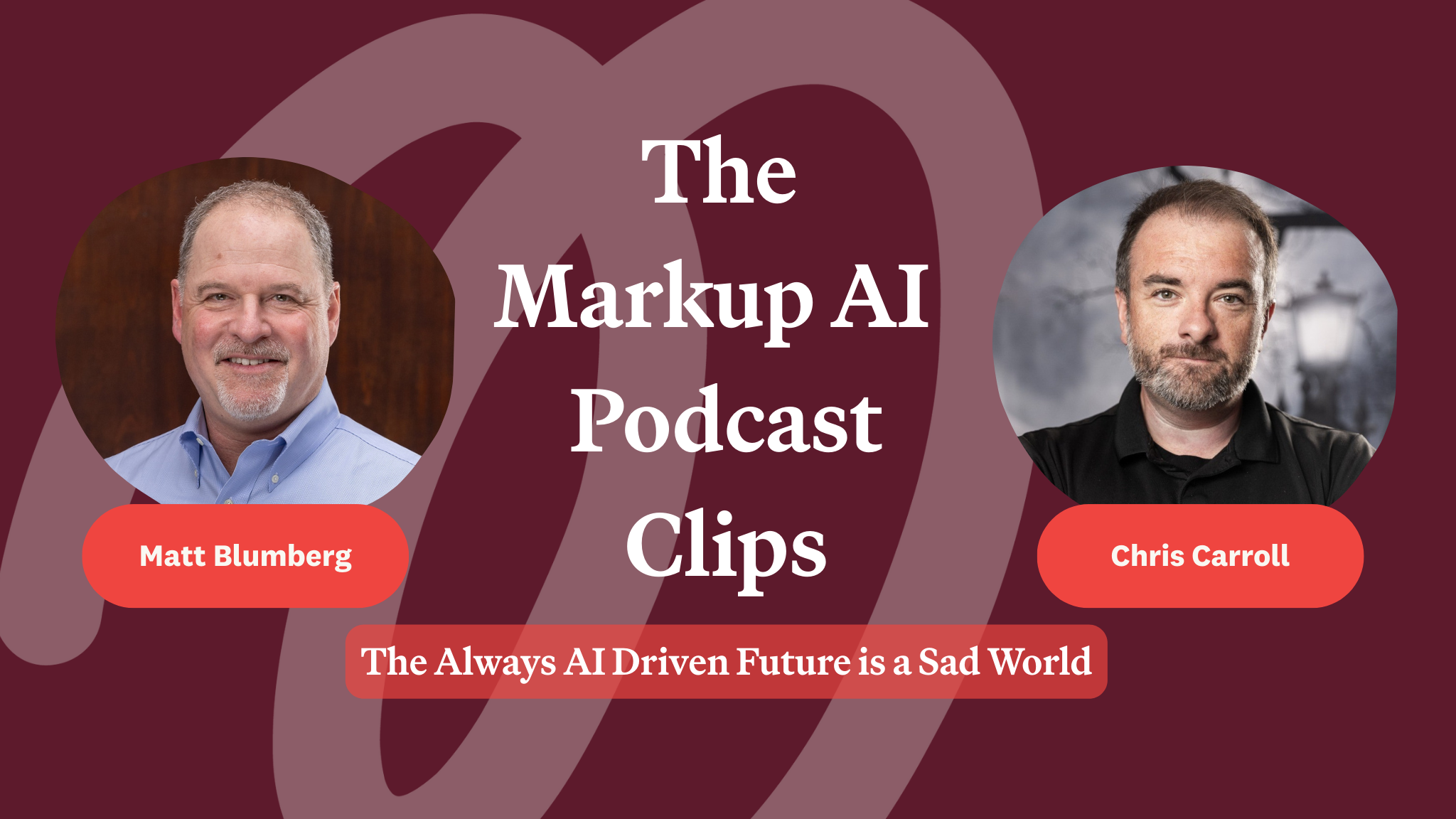
This was the central topic of a recent episode of The Markup AI Podcast. The conversation moved beyond technical optimization to tackle the practical reality of the human experience in an AI-first world.
The verdict? The future isn’t sad — but it’s going to be expensive. We are entering an era where human connection is no longer the default setting of commerce; it’s a luxury product.
The “sad world” fallacy
In a recent episode of The Markup AI Podcast, When we asked Matt Blumberg about a world entirely run by AI, he admitted, “That’s a pretty sad world.” It evokes images of isolation — people interacting with screens that mimic empathy without possessing it.
However, the reality is more nuanced. We aren’t heading toward total sterility, but rather a future defined by points of differentiation.
As AI becomes ubiquitous, its output becomes a commodity. When everyone can generate average copy, code, and art in seconds, the value of “average” drops to near zero. Consequently, the value of what AI can’t easily do skyrockets.
In an AI-driven world, the things that make us “inefficient,” our unpredictability, emotional nuance, and ability to read between the lines, become our greatest assets. The grey background of automated efficiency will only make the color of human creativity pop more vibrantly.
The split between humans and agents in an AI driven world
We’re facing a “dual experience” agency. Businesses will soon need to support two distinct versions of the web in an :
- The human web: Visual, emotional, messy, and designed for eyeballs and brains.
- The agent web: Structured, data-dense, and optimized for AI agents to scrape, analyze, and utilize.
We already see the early stages of this with APIs. But the future suggests a fracture in the user experience itself. Your personal AI assistant might read a text-only version of a site to book a reservation, while you visit a version designed to evoke an emotional response a robot can’t feel.
This bifurcation requires a massive shift. We must stop forcing computers to “see” like humans and stop forcing humans to read like computers. We must acknowledge the split.
Why the internet feels like a 1990s phone tree
This split brings a new frustration, reminiscent of the “Main Line” customer service of the 1990s.
You remember it: “If you know your party’s extension, press 1.” In the near future, the internet may feel like a giant, automated phone tree. When you engage with a brand, you will be funneled through layers of AI triage.
- Need a quick answer? Ask the bot.
- Need a standard transaction? Let the agent handle it.
- Want to speak to a human? Please hold.
We are currently caught in the uncanny valley of automation. Tools are good enough to be deployed by corporations to save money, but bad enough to infuriate customers. The “sad future” isn’t one where robots destroy us; it’s one where we spend 45 minutes trying to convince a chatbot we need a refund.
The rise of the human premium
This leads to a crucial economic insight. In a recent talk Matt attended, a CEO asked an audience: “How many of you would pay extra for customer service that was a live human, in your country, in your native language?”
Eighty percent of the hands went up.
In an AI driven world where we demand everything be free and fast, people are willing to pay a premium for inefficiency. They will pay for the empathy and shared cultural context only another human can provide. This suggests the economy of the future will be tiered:
- Tier 1: The automated baseline (low cost/free). This is the default. AI agents and self-service portals handle 90% of tasks. It’s the “economy class” of the digital world.
- Tier 2: The human premium (high cost). This is the luxury tier. Speaking to a person becomes a status symbol and a marketing differentiator.
How to build a hybrid strategy
You can’t simply automate everything and expect to win. If you replace your entire interface with AI, you are racing to the bottom. To succeed, you must adopt a hybrid strategy:
1. Automate the trivial
Don’t force humans to do robotic work. AI should handle data entry, scheduling, and basic queries. This is where Markup AI helps you scale with confidence. By using Content Guardian Agents℠ to scan, score, and rewrite content for compliance and consistency, you remove the manual burden of quality control.
2. Elevate the human
Use the resources saved by automation to invest in better human interactions. When a customer reaches a human, that employee should be empowered and unhurried. Because Markup AI ensures your automated content is safe and on-brand, your team can focus on complex, high-value problem solving.
3. Offer the choice
Transparency is key. Don’t disguise a bot as a human; that destroys trust. Give users the option between the speed of automation and the quality of human connection.
Is an AI driven world a sad future? It certainly has the potential to be if we allow algorithms to flatten our culture. However, this shift suggests a world where we value humanity more because it’s no longer the only option.
The invention of the camera didn’t kill painting; it forced painting to become more expressive. Similarly, AI won’t kill human connection. It will force connection to become more intentional.
Markup AI helps you navigate this transition. By enforcing content guardrails and ensuring your automated systems speak with your brand voice, we help you build the trust required to offer a true human premium. Learn more in our Definitive Guide to Content Guardian Agents.
Frequently Asked Questions (FAQs)
What’s the “human premium” in AI?
The human premium refers to the increasing value of human interaction as AI automation becomes the standard. As basic tasks become automated and free in an AI driven world, direct access to human empathy, creativity, and problem-solving becomes a luxury service that customers are willing to pay extra for.
How does Markup AI help businesses balance automation and human connection?
Markup AI allows businesses to automate the “trivial” tasks of content compliance and consistency. Content Guardian Agents scan, score, and rewrite content to ensure it meets brand standards automatically. This frees up human teams to focus on high-value, creative, and emotional interactions that AI can’t replicate.
Will AI replace customer service agents?
AI will likely replace the “Tier 1” baseline tasks — answering FAQs, resetting passwords, and processing standard transactions. However, in an AI driven world it will elevate the role of human agents to “Tier 2,” where they handle complex, emotional, or high-stakes issues that require empathy and judgment.
What is the difference between the human web and the agent web?
The human web is designed for visual engagement and emotional connection (what we see today). The agent web is structured data optimized for AI to process tasks efficiently. Successful businesses will need to build content strategies that support both.
Last updated: December 17, 2025
Christopher Carroll
Continue reading

Types of English: A Closer Look at American, British, and Australian English
 •
February 16, 2026
•
February 16, 2026

The Speed of Social: Master Informal Writing Without Losing Brand Authority
•
February 12, 2026

Inclusive Writing: A Guide to Gender-Neutral Language at Scale
•
February 11, 2026
Get early access. Join other early adopters
Deploy your Brand Guardian Agent in minutes.